A hands-free hiking leash and a standard six-foot leash solve two different problems, and most owners buy the wrong one because the difference is not obvious in a store aisle.
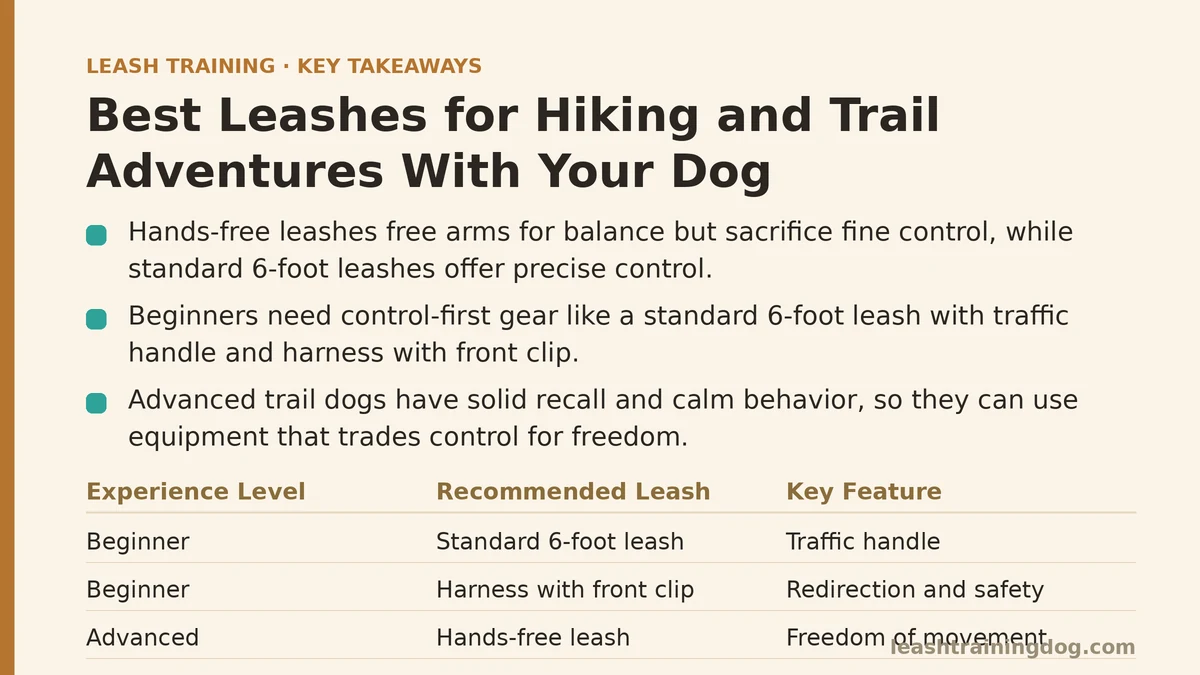
A standard leash gives you precise, moment-to-moment control over your dog’s position. A hands-free leash frees your arms for balance, trekking poles, or scrambling over rocks, but it sacrifices some of that fine control. Neither is universally correct. The right choice depends on your dog’s training level, the terrain you hike, and how predictable your dog is around wildlife and other hikers.
This guide breaks down leash selection by experience level — beginner and advanced — because the leash that works beautifully for a seasoned trail dog can be a liability for a dog still learning recall and impulse control.
Start Here: What Your Dog’s Experience Level Actually Determines
Before looking at specific products, it helps to define what “beginner” and “advanced” mean in a trail context, since they are not about age or breed.
A beginner trail dog is one that has not yet demonstrated reliable behavior around off-leash distractions — deer, other dogs, food left by careless hikers, steep drop-offs. This dog needs a leash system built around control and quick correction, even if they are calm and well-mannered in the backyard.
An advanced trail dog has a demonstrated track record: solid recall, calm behavior when passing wildlife at a distance, no history of bolting toward a trigger. This dog can safely use equipment that trades some control for comfort and freedom of movement, because the training foundation is already in place.
Owners frequently misjudge which category their dog belongs in. A dog that is perfectly obedient on neighborhood walks may become a different animal the first time a rabbit crosses a trail thirty meters ahead. If you have not specifically tested your dog’s recall and impulse control in an outdoor, distraction-heavy setting, assume beginner status until you have.
Beginner Setup: Control-First Equipment
For dogs still building trail reliability, the priority is a leash system that lets you intervene instantly and keeps your dog physically close.
Best Standard Leash: A 6-Foot Leash With a Traffic Handle
For beginner trail dogs, a standard six-foot leash is generally recommended over any hands-free option, and specifically one with a secondary handle positioned about a foot from the clip — often called a traffic handle.
The traffic handle matters more on trails than it does on sidewalks. Narrow paths, blind corners, and sudden encounters with other hikers or dogs require you to shorten your dog’s range instantly without stopping to gather leash length in your hand. Grabbing the traffic handle gives you immediate close control in under a second.
Look for leashes made from webbing rather than rope for this purpose — webbing is easier to grip quickly with wet or gloved hands, which matters more on trails than in town. A leash in the 4-to-6-foot range, made of nylon or polyester webbing with brass or aluminum hardware, is the right starting point. Expect to pay between $15 and $25 for a well-constructed version.
Best Harness Pairing: Front-Clip With a Sturdy Back Handle
A beginner trail dog should be walked in a harness, not a collar, on rougher terrain. A sudden lunge toward wildlife on a collar risks tracheal injury, and a harness with a front clip gives you the redirection mechanics that make a sudden pull easier to manage.
Look specifically for a harness with a reinforced handle on the back — not for leash attachment, but for physically lifting or steadying your dog over obstacles like stream crossings, fallen logs, or narrow rock ledges. This detail is easy to overlook when shopping but becomes essential the first time you need to help a dog across an unstable log bridge.
Why Retractable Leashes Fail on Trails
I want to address this directly because it is the most common mistake I see beginner hikers make. Retractable leashes are poorly suited to trail use regardless of your dog’s training level.
The thin cord offers almost no purchase if you need to grab it quickly, and it can cause serious rope burn or lacerations if it wraps around a leg — yours or your dog’s — during a sudden lunge. On narrow trails, the extended length also means your dog can reach the edge of a drop-off, a patch of poison ivy, or an approaching dog before you have any chance to react. Retractable leashes are designed for open, predictable environments. A trail is neither.
Advanced Setup: Comfort and Range Without Losing Safety
Once a dog has a proven track record — reliable recall, calm behavior around wildlife sightings, no history of sudden bolting — a hands-free system opens up a much more comfortable hiking experience.
Best Hands-Free Leash: Waist-Worn With a Bungee Section
For advanced trail dogs, a hands-free leash that clips around your waist and includes a short bungee or shock-absorbing section is the setup most often recommended.
The bungee section absorbs sudden jolts — a dog spotting a squirrel and lunging two feet before checking themselves — without transferring the full force to your lower back or shoulder. This matters over the course of a multi-hour hike far more than it does on a fifteen-minute neighborhood walk, where a single hard pull is rare rather than a repeated event over rough terrain.
Look for an adjustable waist belt with a quick-release buckle. If you fall, or if your dog needs to be disconnected instantly for any reason, you should be able to unclip the belt with one motion rather than fumbling with a standard buckle.
Length Considerations for Off-Trail Terrain
Advanced hands-free leashes typically run between 5 and 7 feet, sometimes with an adjustable bungee section that extends further under tension. Longer is not automatically better here. On narrow single-track trails, a leash that extends much past six feet allows your dog to range far enough ahead that you lose the ability to react to a sudden trigger — a snake, a steep edge, another hiker’s off-leash dog.
For open terrain with good visibility — wide fire roads, alpine meadows above the treeline — a slightly longer leash gives your dog more room to sniff and explore while remaining connected and manageable. Match the length to what you can actually see ahead of you, not to what feels generous in a parking lot before the hike starts.
Best Long-Line Alternative for Recall Practice
Some advanced trail dogs benefit from off-leash time in appropriate, legal areas, but owners still building confidence in full off-leash reliability often use a long line — 15 to 30 feet of lightweight biothane or nylon — as a middle step.
A long line is not the same category of product as a hands-free hiking leash and should not be confused with one. It is a training tool for supervised recall practice in open areas, not a walking leash for maintaining position on a trail. Biothane is worth the extra cost over nylon for long lines used near water or wet vegetation, since nylon absorbs moisture and becomes heavy and difficult to manage.
Comparing the Two Approaches Side by Side
| Feature | Beginner Setup | Advanced Setup |
|---|---|---|
| Leash type | 6-ft standard with traffic handle | Hands-free waist leash with bungee |
| Control level | High — immediate hand control | Moderate — relies on trained recall |
| Best terrain | Narrow trails, high-wildlife areas | Open trails, established fire roads |
| Harness | Front-clip with lift handle | Front-clip or well-fitted back-clip |
| Price range | $15–30 | $30–50 |
| Risk if misjudged | Low — favors caution | Higher — depends on training accuracy |
A Few Terrain-Specific Notes Worth Knowing
Rocky or scrambling terrain: Regardless of experience level, switch to the shorter standard leash with a traffic handle during any section requiring hands-on scrambling. A hands-free leash attached to your waist can pull you off balance if your dog moves suddenly while you are climbing.
Water crossings: Detach any bungee or elastic hands-free leash before entering moving water. A dog that struggles or is swept slightly downstream can pull you off your footing through the elastic tension in ways a standard leash will not.
Wildlife-dense areas: Even advanced dogs should move to the shorter, traffic-handle leash in areas with known bear, moose, or off-leash coyote activity. Training reliability and split-second reaction time are two different things, and the shorter leash favors the latter.
Cold weather hikes: Webbing leashes stiffen and become harder to grip in freezing temperatures. Biothane holds up better in cold conditions and is worth considering for regular winter trail use.
The Bottom Line
Match the leash to the dog you have today, not the dog you hope to have by next season. A beginner setup that prioritizes control costs you a little convenience. An advanced setup used prematurely costs you the ability to react when it matters most.
If you are unsure which category fits your dog, spend a few hikes on the control-first setup while deliberately testing recall and calm behavior around distractions at a safe distance. Move to the hands-free system only once that track record is established, not before.
Tell me your dog’s age, hiking experience, and how they typically react to wildlife or other dogs on trail — I will help you figure out which setup makes sense to start with.
Related guides: Best Hands-Free Leashes for Runners and Joggers: 5 Ranked After Mileage Testing, Nylon vs. Leather vs. Biothane Leash: Which Material Is Best for Your Dog?, and How Long Should a Dog Leash Be for Training: The Answer Depends on What You Are Teaching.