By the time you finish this post, you will be able to pick a treat pouch that matches your dog’s size and your walking routine, load it correctly for fast rewards, and use it in a way that keeps one hand permanently free for the leash. That last part matters more than most people expect — a pouch that forces you to fumble is a pouch that undermines your timing, and timing is most of what makes leash training work.
Many owners try to train loose leash walking with treats stuffed in a jacket pocket or a sandwich bag held in one fist. It works for about five minutes before the treats get greasy, the bag crinkles and spooks the dog, or the owner needs both hands for something else and has nowhere to put the leash. A good treat pouch solves a problem that looks small and turns out to be central to good training mechanics.
Below are the questions most commonly asked about treat pouches, answered with practical guidance for real training sessions.
Why does a treat pouch matter for leash training specifically?
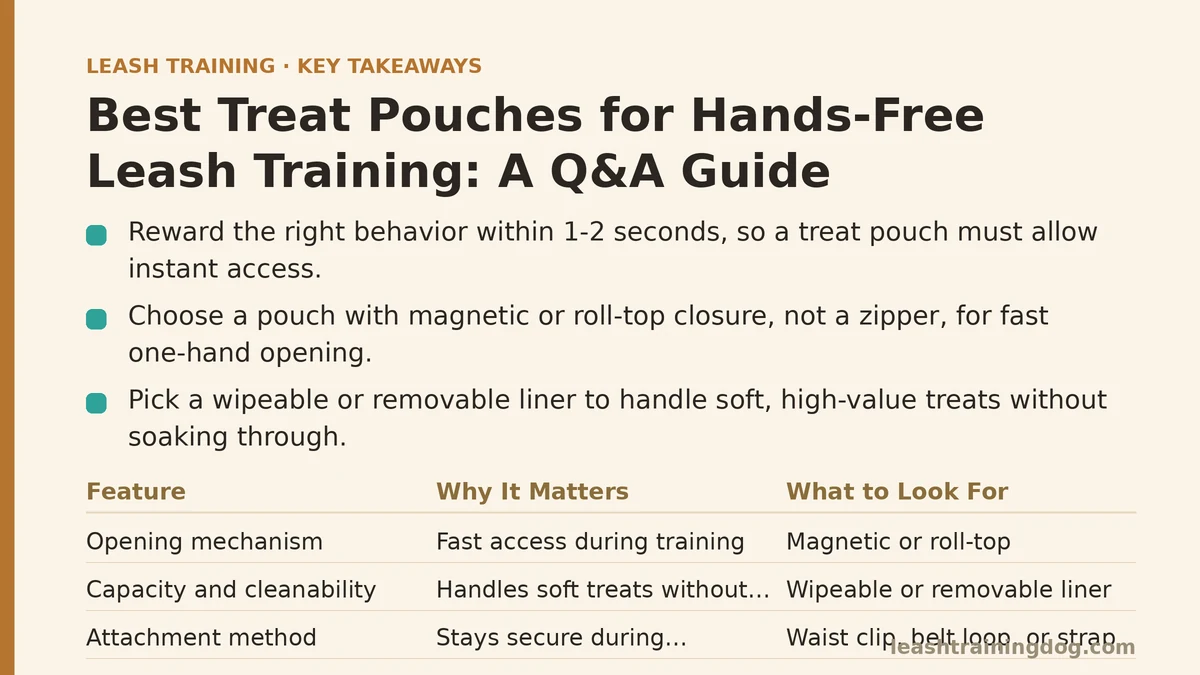
Leash training — loose leash walking, reactivity work, recall on a long line — depends on rewarding the right behavior within about one to two seconds of it happening. A dog that checks in with you, or walks past a trigger without lunging, needs a treat delivered almost instantly for the association to form correctly.
If your hand is in a pocket digging for a treat while holding the leash in the same hand, you lose that window. The dog has already moved on to the next thing by the time the treat arrives, and the reward ends up reinforcing whatever the dog is doing at that moment — which might not be what you wanted to reinforce at all.
A treat pouch worn at the waist keeps both hands available: one for the leash, one for quick, repeatable access to the reward. It also keeps treats from smelling up your pockets, which sounds trivial until you have worn the same jacket for three weeks of hot dog training sessions.
What should I actually look for when choosing one?
Four things determine whether a pouch works well in practice, and none of them are about how it looks in a product photo.
Opening mechanism. Magnetic closures and roll-top designs that snap open with one hand are far faster than zippers during a live training moment. A zipper pouch is fine for a walk around the block; it is a liability the moment you need a treat delivered in under a second because your dog just noticed another dog across the street.
Capacity and cleanability. Pouches with a wipeable liner or a removable liner handle soft, high-value treats — cheese, hot dog, liver — without soaking through the fabric within a week. This matters more than most buyers expect the first time they read a review.
Attachment method. A waist clip, a belt loop, or a built-in adjustable strap all work, but they need to sit securely enough that the pouch does not swing or bounce during a fast-paced walk or a training session with lots of movement.
Odor control. Some pouches include a rubberized or silicone-lined interior specifically to hold onto strong-smelling treats without transferring the smell to your hands and clothes between sessions.
Which treat pouches do you actually recommend?
These five are commonly used and re-used across dog sizes and training goals. None of them are sponsored picks — they are the ones that tend to survive repeated real-world use in a training bag.
1. PetSafe Treat Pouch — Best Overall
This is the pouch I hand to most new clients because it balances price, durability, and ease of one-handed use. The magnetic closure snaps shut on its own after you reach in, which sounds like a small detail until you realize how often treats spill out of pouches with weaker closures during a brisk walk.
Best for: most dogs and most training goals, especially owners new to treat-based training who want something that just works without a learning curve.
Limitations: the interior is fabric rather than a wipeable liner, so very greasy treats will eventually leave a smell that requires regular washing.
2. Rogz Trainer Pouch — Best for Wet, High-Value Treats
The fully wipeable rubberized interior is the reason this pouch earns a spot on the list. For dogs that need the highest-value reward available — freeze-dried liver, boiled chicken, cheese cubes — this pouch handles the mess without soaking through.
Best for: reactive dog training and any program where you are using the strongest possible reinforcer.
Limitations: the opening is a drawstring rather than a magnetic snap, which is slightly slower to access mid-walk than the top picks on this list.
3. Dexas MudBuster Treat Tote — Best Capacity
For long training walks or multi-dog households where you are refilling less often, this pouch’s larger main compartment holds significantly more volume than most competitors without becoming bulky at the waist.
Best for: long sessions, multiple dogs, or handlers who prefer not to stop and refill mid-walk.
Limitations: the extra volume adds some bulk, which a few smaller-framed handlers find gets in the way during fast movement.
4. Doggone Good Treat Tote — Best Budget Option
At roughly half the price of the premium options, this pouch still includes a basic wipeable liner and a functional belt clip. It will not survive years of daily heavy use the way the PetSafe or Rogz will, but for owners testing whether hands-free training suits them, it is a sensible starting point.
Best for: owners just beginning treat-based training who want to confirm the habit sticks before spending more.
Limitations: the clip mechanism loosens over time and needs occasional tightening or replacement.
5. Mighty Paw Treat Pouch — Best for Small Dogs and Minimalist Carry
This is a slimmer, lighter design that sits close to the body — useful for smaller dogs where a bulky pouch looks and feels disproportionate, or for handlers who simply prefer a low-profile option.
Best for: small breed training, jogging with a dog, or anyone who finds larger pouches cumbersome.
Limitations: the smaller main compartment holds less treat volume, so it needs more frequent refilling on long walks.
How do I wear and use one correctly?
Clip or thread the pouch onto a waistband, belt, or the pouch’s own strap so it sits at your hip, slightly to the side rather than directly in front. Directly in front tends to interfere with arm movement and can bump against your dog during heel-position work.
Load it before you leave the house, not once you are already outside with a leash in one hand. Break treats into pieces roughly the size of a pea for most training work — small enough to deliver quickly and repeatedly without filling your dog up halfway through the walk.
Practice reaching into the pouch and delivering a treat without looking down. This sounds minor, but the moment you glance away from your dog to locate the opening, you lose visual tracking of triggers and behavior — exactly the moment reactive dogs tend to escalate. A few minutes of practice at home, treating an imaginary dog, builds the muscle memory before you need it on a real walk.
Can I just use a pocket or a fanny pack instead?
You can, and for very calm dogs on quiet routes it may be enough. But pockets create two specific problems: the fabric muffles your hand movement so treats are slower to locate, and most jacket pockets are not designed to be wiped clean, so they end up smelling of liver indefinitely.
A generic fanny pack works reasonably well if it has a single-handed opening, though most are not designed with the durability or scent control that dedicated dog treat pouches include. If you already own one and it opens easily with one hand, there is no need to replace it immediately — but if you are shopping specifically for training gear, a purpose-built pouch will serve you better over the long run.
Does the pouch matter more for reactive dogs than for calm ones?
It matters more, not less. Reactive dog training depends on delivering treats within a second or two of your dog noticing a trigger — a car, another dog, a jogger — before the reactive behavior has a chance to start. Any delay in accessing a treat during that window reduces the effectiveness of the counter-conditioning work.
For reactive dogs, choose a pouch with the fastest possible opening — magnetic snap over zipper, wide mouth over narrow — even if it means sacrificing some capacity or refilling more often during the walk.
What is the single biggest mistake owners make with treat pouches?
Wearing the pouch but still transferring treats into a hand before the walk even starts, then holding a closed fist the entire time. This defeats the purpose. The pouch should stay closed until the exact moment a treat is needed, so your dog’s attention is on you and the environment rather than fixated on a visible or smelled treat the whole walk.
The second most common mistake is loading treats that are too large or too crumbly. Oversized treats slow down the reward delivery and can turn a quick training moment into a chewing break that breaks your dog’s focus on the leash work.
Quick Comparison
| Pouch | Best For | Opening Type | Price Range |
|---|---|---|---|
| PetSafe Treat Pouch | Most dogs, all-around use | Magnetic snap | $15–20 |
| Rogz Trainer Pouch | High-value, wet treats | Drawstring | $18–25 |
| Dexas MudBuster Tote | Long sessions, multiple dogs | Zipper | $20–28 |
| Doggone Good Tote | Budget, beginners | Zipper | $10–15 |
| Mighty Paw Pouch | Small dogs, minimalist carry | Magnetic snap | $15–22 |
A treat pouch will not fix leash pulling or reactivity on its own — no piece of equipment does that job by itself. What it does is protect your timing, and timing is the part of training that owners underestimate until they see how much faster their dog progresses once rewards arrive at exactly the right moment.
What size is your dog, and what are you training — loose leash walking, recall, or reactivity work? Tell me in the comments and I will suggest which pouch on this list fits your specific setup.
Related guides: Choosing a Puppy’s First Leash and Collar: The Professional’s Step-by-Step Guide, Slip Lead vs Standard Leash: Which Is Better for Training?, and Leash Handling for Food Delivery Workers Walking Dogs Safely on Route.