Say you are standing in a wide open park, your dog has just locked eyes with a squirrel forty meters away, and you call their name with the exact tone you have rehearsed for eight weeks. Your dog glances back at you, hesitates for half a second, and then commits to the squirrel at full sprint.
The walk home is quiet. You have been practicing recall daily, using high-value treats, following every guide you could find. Somehow, the training is not transferring to the real world the way the articles promised it would.
That gap between practiced obedience and real-world reality is not a training failure on your dog’s part. In years of evaluating recall issues, the same five patterns tend to repeat across hundreds of owners. Each one looks like a dog problem from the outside. Each one is, in practice, a timing or repetition problem the owner can fix within two weeks.
Here are the five most commonly corrected recall mistakes, ranked by how frequently they tend to appear — and what to do about each one starting today.
#5: Calling Your Dog Only When Something Better Is About to Happen
The mistake: You call your dog to clip on the leash, to leave the park, to get in the car, or to stop doing something fun. Every recall in your training session carries the hidden message: the good part ends now.
Dogs are exceptional statisticians. If nine out of ten recalls in your daily routine lead to the leash, the car, or the end of playtime, your dog is not ignoring the command — they are accurately predicting that coming when called costs them something they value. The recall word itself has been poisoned by association.
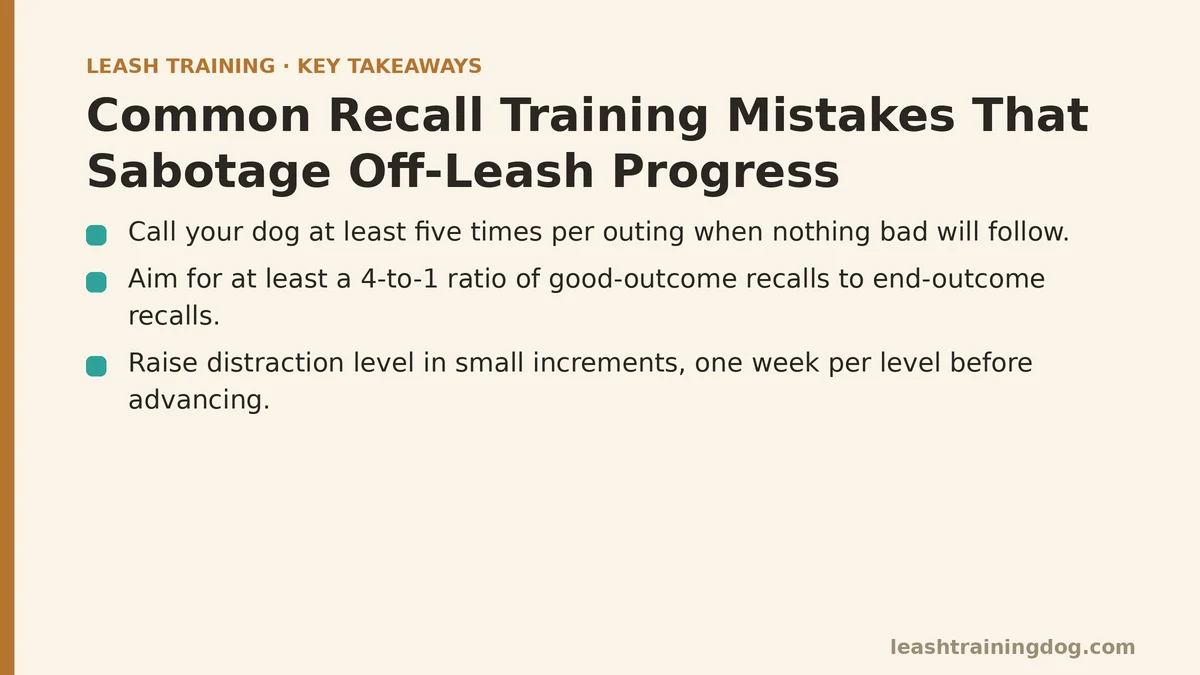
The fix: For the next ten days, call your dog at least five times per outing when nothing bad will follow. Call them, reward with a high-value treat the moment they arrive, and then release them back to whatever they were doing with a cheerful “okay!” Do this mid-play, mid-sniff, mid-exploration. Your dog needs at least a 4:1 ratio of good-outcome recalls to end-outcome recalls before the word feels safe again.
How you’ll know it’s working: Your dog starts arriving at a trot rather than a reluctant walk. That change in approach speed is the earliest measurable signal that the association is shifting.
#4: Practicing Only in a Boring Environment
The mistake: All your recall practice happens in your living room or fenced backyard. Your dog nails it every time — from three meters away, with no distractions, nothing competing for their attention. Then you take them to the park with the first interesting smells and moving objects they have encountered all week, and the skill collapses.
Recall is not a trick. It is a decision your dog makes in a landscape crowded with competing options. A quiet living room teaches the mechanics. It does nothing to build the habit of choosing you over a fascinating scent trail or another dog.
The fix: Raise the distraction level in small, deliberate increments. Start in your yard, then move to a quiet sidewalk, then a park with dogs at a distance of at least fifty meters, and only then work toward open-field off-leash settings. Before each step up in distraction, spend one full week practicing at the current level until recall is reliable at three out of three attempts across separate sessions. Rushing the progression is the most common way owners end up with a recall that only works at home.
A specific number to aim for: At each new distraction level, your dog should respond to their name within two seconds and return to within arm’s reach — not just within the general area — before you increase difficulty further.
#3: Using One Word for Too Many Things
The mistake: Your dog hears their name (“Cooper!”), hears “come,” hears “here,” hears “let’s go,” and hears “Cooper, come here” — all in the same session, when you are feeling frustrated. Each variation sounds different enough to your dog that the association stays weak across all of them.
Dogs learn specific sound patterns, not general concepts. A dog that has been trained with “Cooper, come!” responds to that exact sequence. When you switch to “here, boy” mid-stress, they are not being stubborn — they have simply never been conditioned to that phrase.
The fix: Pick one word — “come” is the standard — and commit to it exclusively for recalls during the next month. Do not use it for anything else. When you want your dog to walk with you, say “let’s go.” When you want them to move off the couch, say “off.” Reserve your recall word as a single, sacred, never-diluted signal. Keep your dog’s name as an attention-getter only — say it, wait for eye contact, then give the recall word.
A caution: If you have already trained multiple words, the fix is simple but requires discipline. Every time you catch yourself using a different word for recall, take a breath and use the chosen one instead. Consistency for two weeks is enough to rebrand the signal in most dogs.
#2: Rewarding Arrival Only, Not the Entire Return
The mistake: Your dog comes back to you eventually — after circling the tree twice, after sniffing one more patch of grass, after pretending not to hear you. You reward them anyway because at least they came back.
Here is what that repetition teaches: coming when called does not need to be prompt or direct. The dog learns that a slow, meandering return earns the same cookie as a sprint straight to your side. Over time, the recall becomes a suggestion rather than a command, and the delay grows longer with each repetition.
The fix: For the next ten training sessions, only reward recalls where the dog arrives within three seconds of the command and comes directly to you without detours. If your dog takes longer or wanders on the way, do not punish — simply do not reward, and try again from a closer distance. In practice, this means setting your training sessions at an easy distance (five to ten meters) where success is highly likely, and gradually extending the distance as prompt, direct returns become the norm.
The mindset shift: You are no longer rewarding “eventually.” You are rewarding “immediately and directly.” The distinction is the entire difference between a recall that works in an emergency and one that works only in theory.
#1: Calling Your Dog When You Cannot Enforce It
The mistake: You let your dog off-leash in an unfenced area for the first time. They wander a bit further than you expected. You call. They do not come. You call again, louder. Nothing. You call a third time, with frustration creeping into your voice. Your dog now hears the recall word repeatedly, in a moment when nothing happens afterward — no reward, no consequence, no change in the situation.
This is the fastest way to destroy recall that I know of, and it happens in a single afternoon. Your dog learns that the recall word is optional, because you demonstrated — without meaning to — that nothing follows a missed command. Each repeated call without enforcement trains the exact opposite of what you want: the word means less, not more.
The fix: Never give a recall command you cannot make happen. For the first several off-leash sessions in a new space, use a long line — a 15-meter training leash — so you can physically reel your dog in if they ignore the call. The sequence matters: say “come,” and if they do not respond within three seconds, apply steady, gentle pressure on the line to guide them in, then reward the moment they reach you. Do not repeat the command while the line is doing the work. Let the pressure be the consequence, and let the reward follow the correct response.
How you’ll know you can lose the line: Once your dog responds promptly nine times out of ten on the long line in that specific space, for two consecutive sessions, you can switch to off-leash confidence. If a session goes badly, put the line back on for a few more rounds rather than pushing through — rebuilding trust in the word is always faster than repairing a freshly trained habit of ignoring it.
Quick Reference: The Five Mistakes and Their Fixes
| Rank | Mistake | The Hidden Message | The Fix |
|---|---|---|---|
| 5 | Calling only when fun ends | “Coming means losing something” | 4:1 reward-only recalls daily |
| 4 | Practicing only in boring spaces | “Recall works only when nothing competes” | Step up distraction in increments |
| 3 | Using multiple words for recall | “The signal is vague and weak” | One word, exclusively, for 30 days |
| 2 | Rewarding slow or distracted returns | “Arriving eventually is fine” | Reward only prompt, direct returns |
| 1 | Calling without ability to enforce | “Ignoring the word is fine” | Use a 15m long line until reliable |
A Recovery Plan for a Recall That Has Already Deteriorated
If your dog has already learned to ignore the recall word, the fix is not more practice — it is a systematic rebuild. Here is the sequence owners are typically asked to follow, and it can often restore a usable recall within two to three weeks.
Week 1: Keep your dog on a leash or long line at all times. Do not use your recall word at all. For the first three days, do not test it once. Instead, rebuild the association using a brand-new word — pick something neutral like “here” or “now” — and practice it in controlled sessions, five to ten repetitions per day, with high-value treats and zero negative outcomes at the start of each session.
Week 2: Begin using the new word in low-distraction real-world spaces while still on the long line. Enforce every single command. If you call and they do not arrive within three seconds, reel them in with the line and reward the arrival. This teaches the pattern that matters: the word leads to a treat, and the line makes the arrival happen.
Week 3: Phase out the long line in safe spaces, starting with quiet times of day. Use your judgment on each session: if your dog ignores two recalls in a row, the space is not ready yet, and you go back to the line for that location. The goal is no more than one ignored command per week once you are off-leash.
The Bottom Line
Nearly every recall failure investigated over the last decade has traced back to one of these five patterns. None of them are a dog being stubborn. None of them require a firmer tone or a harsher tool. All of them are fixable with a change in how you deliver the command and what follows it.
The most important thing you can do today is pick one mistake — the one that describes your recent sessions most closely — and correct it for a full week. Not all five at once. One threshold at a time.
What is your dog’s most common recall scenario right now — park, yard, or street — and which of these five patterns shows up when they ignore you? Leave a comment with those two details and I will tell you exactly which order to tackle your fixes in.
Related guides: Teaching Recall to Your Dog: A Beginner Step-by-Step Tutorial, Leash Training Your Dog to Walk Politely Around Distractions, and How to Teach Heel Command to Your Dog: The Method That Builds Real Precision.