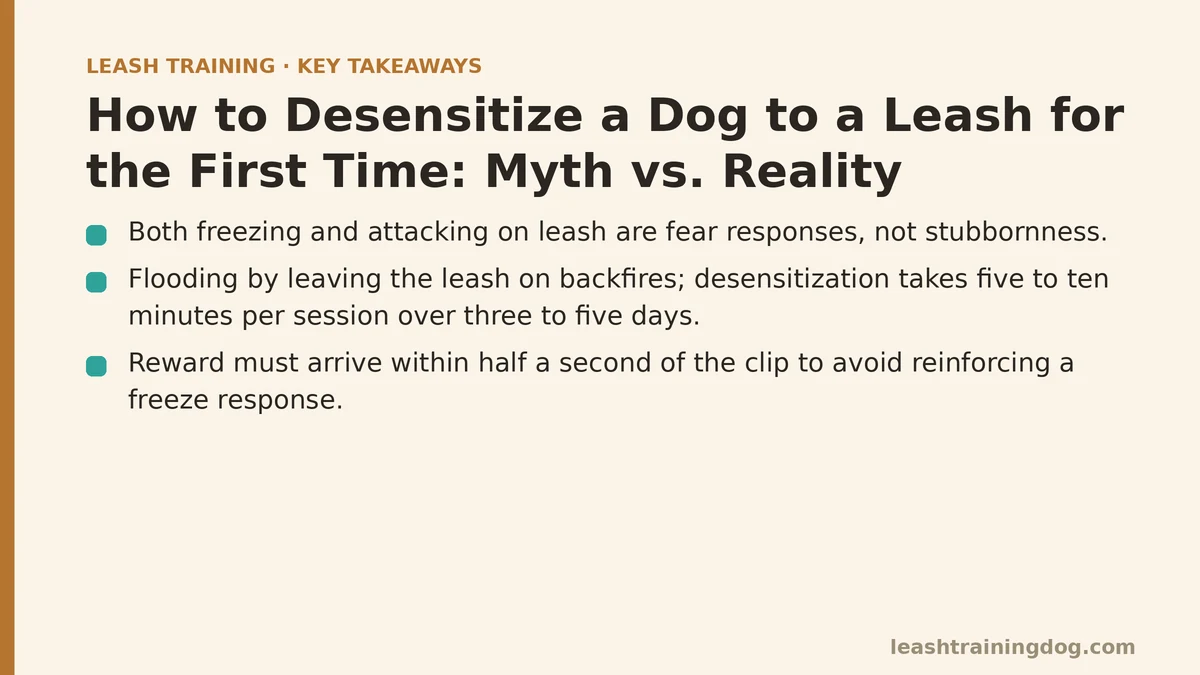
There are two kinds of dogs that haven’t been leash-trained yet: the ones who freeze like a statue the second the clip touches their collar, and the ones who treat the leash like an aggressive snake that must be attacked. Most owners assume both are “being difficult.” In practice, neither is being difficult — both are showing a fear response, and the difference between them is only whether that fear turns inward (shut down) or outward (fight). The training approach for each starts in the same place, but the pace and the signals you watch for are different.
Here’s the myth that costs owners the most time: “If I just leave the leash on long enough, the dog will get used to it.” That is what experts call flooding — and it consistently backfires. A dog left in a panic state for an hour learns that the leash predicts a long, inescapable sense of dread. The result is a dog that is quieter but more anxious underneath — and that anxiety leaks out later as resource guarding, house soiling, or explosive reactions the moment the leash comes out of the drawer.
The reality is that desensitization takes five to ten minutes per session, spread across three to five days, and uses a specific pattern of exposure that keeps your dog under their “fear threshold” the entire time. This guide walks you through that pattern, myth by myth, so you can skip the flooding mistake and build a dog that sees the leash as a cue for the walk — not a cue for panic.
Myth #1: “A puppy under six months doesn’t need desensitization — they’ll just grow into it.”
The reality: Puppies have a critical socialization window that closes around 14 to 16 weeks. During that window, new objects and experiences are absorbed as neutral or positive at a much faster rate than at any later age. If a leash is first introduced after that window closes, the novelty alone can register as a mild threat. That’s not stubbornness — it’s a developmental boundary.
What to do instead: The age doesn’t determine whether you desensitize; it determines how fast the desensitization sticks. For puppies under 16 weeks, a single session of five minutes with the leash draped across your palm and a steady stream of treats is often enough to generalize to the next session. For adult dogs, budget an extra day or two of groundwork with the leash just sitting in a visible spot near their food bowl before you ever touch their collar with it.
The measurable benchmark: You know the first stage is complete when your dog will sniff the leash voluntarily — not because you’re holding it near them, but because they approach it on their own. That voluntary approach is the green light to move to the next step.
Myth #2: “Clip the leash on, give a treat, and keep walking. The treat will fix it.”
The reality: Timing matters more than the treat itself. If you clip the leash and your dog freezes, and then you give a treat, you have just reinforced the freeze. The dog learns that standing still and shutting down produces food. That’s not what you want. You want the dog to associate the clip itself with something positive — which means the reward needs to arrive within half a second of the clip, before any panic response has time to build.
What to do instead: Break the clip into two parts. First, touch the leash clip to the collar ring without closing it. Reward instantly. Release the pressure. Then touch the clip and close it. Reward instantly. Unclip. Repeat this five times in a row, watching for any tension in the dog’s body — stiff legs, tucked tail, ears pinned back. If you see tension on repetition three, go back to touching without clipping for two more repetitions.
The mistake to recover from: If your dog already froze mid-session, don’t keep going. Unclip, set the leash down, and end the session. Wait two hours, then restart at the “touch without clipping” step. The session that ended in a freeze is not a failure — it’s information that your dog’s threshold sits lower than your current pace assumed.
Myth #3: “A dog that bites the leash is aggressive — use a sturdier leash or a correction.”
The reality: Leash biting is almost always redirected frustration or a play response gone wrong, not aggression toward you. The dog is not trying to hurt you — they are trying to make the scary object go away, and since the leash is the object in their face, they attack it. Adding pain via a correction on a dog that’s already in a defensive state tends to make the biting worse, because the dog learns that close proximity to the leash predicts discomfort.
What to do instead: Desensitize the leash as a stationary object before it ever becomes a moving one. Lay the leash flat on the floor, let the dog investigate it, and scatter treats around it. Then move the leash gently side to side while feeding treats. Then drag it slowly on the ground while walking backward and dropping treats ahead of you. Only after the dog watches the leash move without interest do you pick it up and repeat the same sequence in your hand.
The specific threshold to watch: A dog that bites the leash at rest is a different case from a dog that bites it only when it moves. If your dog is fine with a still leash and reactive to a moving one, spend two full sessions dragging the leash on the ground before you ever hold it near the collar. That split is the most common one owners miss.
Myth #4: “Desensitization means exposing the dog to the leash until they ignore it.”
The reality: Ignoring is not the goal. Engagement is the goal. A dog that ignores the leash has learned to suppress their response — which is better than panicking but still leaves a low-grade stress hum running underneath. A dog that engages with the leash — sniffs it, looks at it, then looks back at you expecting a treat — has built a positive association that will carry through the first walk without any anxiety.
How to tell the difference: Watch the dog’s tail and ears. A dog that ignores the leash has a neutral tail but may have one ear slightly back, which indicates they are tolerating the object but not comfortable with it. A dog that engages with the leash has a loose, wagging tail (not tucked, not stiff), forward ears, and a soft blink or lip lick when the leash appears.
What to do instead: Every time the leash appears — when you pick it up from the drawer, when you carry it to the door, when you set it on the floor — say a specific cue word like “leash!” and drop a treat. After thirty to fifty repetitions spread over two days, the word “leash” itself becomes a signal that something good is coming. That word becomes your anchor for the actual walk.
Myth #5: “First walk will take twenty minutes — plan for a long session.”
The reality: The first walk should take less than five minutes, and half that time should be spent standing still. The goal is not to get from your front door to the corner. The goal is to practice clipping, unclipping, and taking two steps in your driveway or hallway — then stopping, treating, and going inside.
Why this works: Every time you bring a dog back inside while they are still calm, you close the training session on a success. Dragging a scared dog on a twenty-minute walk produces exactly one lesson: “walks are long, scary, and inescapable.” A two-step driveway session produces the lesson: “walks are short, predictable, and end with treats and safety inside.”
The specific protocol:
- Clip the leash using the two-step method from Myth #2
- Walk two steps forward, stop
- Feed three treats slowly, one at a time
- Turn around, walk two steps back to the door
- Unclip, give a final treat, go inside
- Repeat this three times total, with a fifteen-minute break between repetitions
Most dogs are ready to add five more steps per day after two days of this protocol. Some need a week. The dogs that need a week are not slower learners — they are dogs with a higher baseline sensitivity, which means they trade speed of learning for depth of association, and those associations tend to be the strongest ones.
Quick Decision Branch: What to Do for Your Dog Right Now
| If you observe this | Do this today | Do not do this |
|---|---|---|
| Dog freezes when leash touches collar | Practice “touch without clipping” for 5 minutes | Leave the leash clipped on while you watch TV |
| Dog attacks a moving leash | Drag the leash on the floor, scatter treats, do not hold it yet | Correct the bite or yank the leash away |
| Dog is fine with leash but panics at the door | Start at the door with no leash; feed treats near the doorframe for 3 days | Clip the leash and pull them through the doorway |
| Dog panics after a previous bad experience with a leash | Go back to the floor-dragging stage and spend a full week there | Assume the prior fear is “past and we’re starting fresh” — it isn’t |
| Dog is a puppy under 12 weeks | Do 3 sessions of 3 minutes, spaced across a day | Skip desensitization because “puppies adapt fast” |
The Common Mistake That Wastes the Most Time
The mistake is not moving too fast. The mistake is moving too fast and then stopping — because the dog gives you one good session, you assume the next session will be the same, and then when the dog regresses on session four, you interpret it as a personality trait rather than a normal part of the process.
Desensitization is not linear. Session one might be excellent. Session two might be a full regression. That regression is the dog consolidating what they learned in session one — it’s not a failure. What matters is whether the trend across ten sessions is upward. If sessions one, two, and three are all calm, and session four is a freeze, the correct response is to drop back to the previous step for two sessions and re-attempt. If you push through the freeze, you reset the whole process.
What to Do Today (The 10-Minute Version)
Choose one step — the lowest touch point your dog can handle comfortably. For most dogs that’s “leash in the room, dog eats treats near it.” For others it’s “leash in your hand, dog sniffs it.”
Run that step for 5 minutes — set a timer. Do not go past 5 minutes even if the dog looks great. The point is to end early, not on the last possible minute of calm.
End on a voluntary interaction — the ideal ending is the dog sniffing the leash or approaching it on their own, followed by you setting the leash down and walking away. Do not end while the dog is actively panicking. If they panic, that’s fine — you still end, but you wait two hours before the next session.
Repeat the same step tomorrow — twice, morning and evening, until the dog shows no tension for two consecutive sessions. Then move up one step: touch the clip to the collar, drag the leash on the floor, hold the leash upright, or step toward the door.
Write down what the dog did — one sentence is enough. “Froze for 3 seconds at clip, then relaxed.” That sentence, across a week, tells you more about the right pace than any general advice can.
The Bottom Line
Desensitization to a leash is not a single trick. It is a sequence of small exposures, each one staying under the dog’s fear threshold, each one ending early, each one rewarded. The dogs that look impossible to leash-train are often just dogs whose owners skipped one of the intermediate steps — usually the step where the leash is a stationary object in the room rather than a moving thing attached to their neck.
Start with the lowest step you can find, run it for five minutes today, and end while your dog is still calm. Do that twice tomorrow. By the end of the week, you will have a dog that sees the leash as a cue for a short, safe, treat-filled ritual — not a source of fear.
Tell me in the comments which symptom your dog shows (freeze, bite, or bolt) and what step you plan to start with today. I’ll reply within 24 hours with a specific adjustment to your plan if needed.
Related guides: Choosing a Puppy’s First Leash and Collar: The Professional’s Step-by-Step Guide, How to Leash Train a Rescue Dog With Unknown History: Myth vs Reality, and Best Treat Pouches for Hands-Free Leash Training: A Q&A Guide.