People often confuse training a blind dog with training a nervous dog. They are not the same project. A nervous dog needs confidence built around specific triggers. A blind dog needs an entirely new information system — one built on touch, sound, and predictable routine, because the sense they relied on for spatial awareness is gone or going.
I want to walk through one case in detail rather than give you a generic checklist, because the details are where blind-dog leash training actually lives. A typical case involves a dog like Willow, a six-year-old Australian Shepherd, and the way an owner and trainer work through leash training over about ten weeks maps onto almost every blind dog.
How Willow Lost Her Sight
Willow’s owner, Diane, called me because Willow had stopped walking. Not stopped pulling — stopped walking entirely. She would freeze at the door, refuse to step off the porch, and if pushed gently forward she would flatten to the ground and tremble.
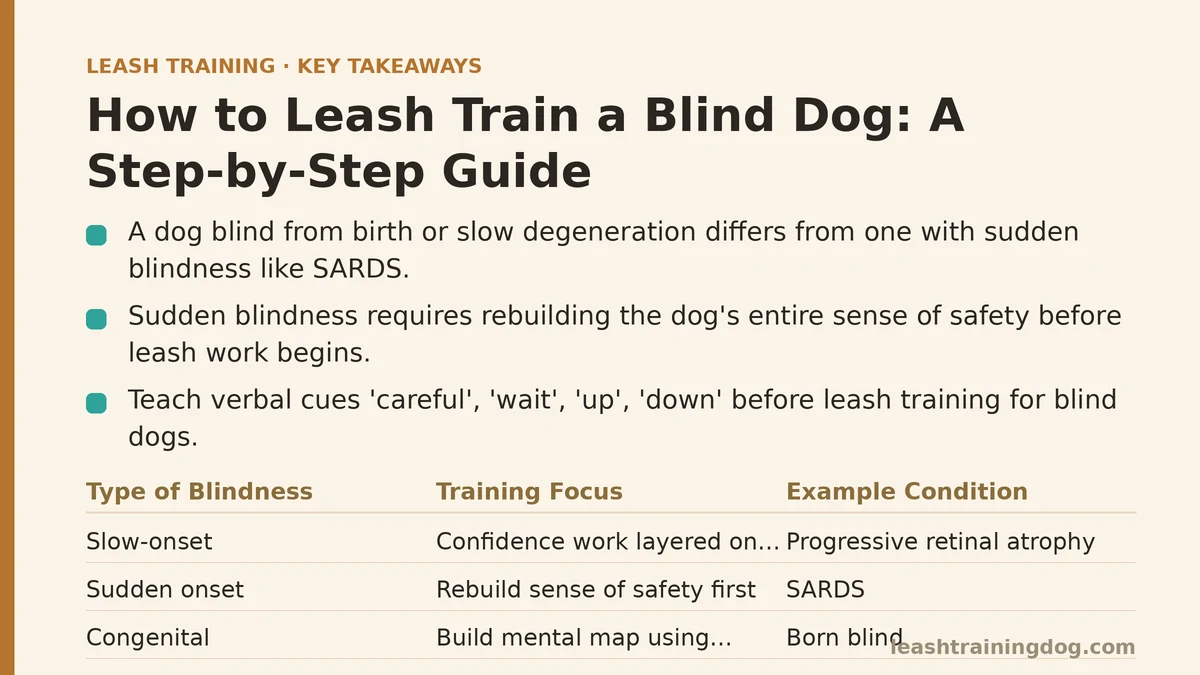
Willow had SARDS — Sudden Acquired Retinal Degeneration Syndrome — and had gone from fully sighted to functionally blind over roughly three weeks. This detail matters enormously for training strategy. A dog blind from birth or from a slow degenerative process has time to build a mental map of the world using other senses as vision fades. A dog like Willow lost her primary sense almost overnight, with no transition period to adapt.
That distinction changes everything about where you start. Slow-onset blindness often needs confidence work layered gradually onto existing habits. Sudden blindness needs to rebuild the dog’s entire sense of safety before leash work can even begin.
Week One: Rebuilding Trust Before Touching the Leash
I did not put a leash on Willow during our first two sessions. There was no point. A dog that does not trust her environment will not walk calmly on a leash regardless of equipment or technique.
We started indoors, in one room Willow already knew well. Diane sat on the floor and called her using a single consistent word — “here” — paired with a treat every time Willow approached. Within a session, Willow was moving toward the sound of Diane’s voice with less hesitation. This sounds unrelated to leash training, but it is the foundation everything else sits on: a blind dog needs absolute confidence that voice cues predict safety before she will trust a leash pulling her toward the unknown.
We also introduced a verbal marker for movement itself. Every time Willow took even one step forward voluntarily, Diane said “good” and rewarded. This built an association between forward motion and safety that we would rely on constantly once we moved outside.
Week Two: The Vocabulary System
Before Willow ever wore a harness for a walk, she needed a working vocabulary. Sighted dogs read the world visually — a curb, a step, an obstacle. Blind dogs need verbal warnings delivered a half-second before they reach the thing they cannot see coming.
We built four words:
“Careful” — spoken one to two steps before any change in surface or elevation, such as a curb, step, or uneven ground.
“Wait” — a full stop, used before doors, stairs, and street crossings.
“Up” and “down” — for stepping onto or off a raised surface, taught first on a single low step indoors before ever being used outdoors.
Teaching these words came before leash training, not during it. Diane practiced “careful” on a folded towel placed on the floor, saying the word every time Willow’s paw approached the edge, until the word alone made Willow slow down and feel forward with her paw before stepping. That single behavior — feeling before stepping — became the core skill that made outdoor walks possible later.
Week Three: Choosing Equipment That Communicates
For Willow, we moved away from a standard collar entirely. A collar transmits leash pressure to the neck in a way that can startle a dog who cannot see the correction coming, and a sudden neck jolt on a blind dog often produces a fear spiral rather than a simple redirection.
A well-padded front-clip harness, similar to the kind recommended for dogs that pull, can help here, but for an entirely different reason. The harness distributes pressure across the chest and shoulders rather than concentrating it at one point, which makes leash pressure feel like gentle guidance rather than a jarring signal. We paired it with a short, sturdy leash — no retractable leads, ever, for a blind dog, since the variable tension of a retractable leash is confusing and occasionally frightening when you cannot see what is causing it.
One addition that made a measurable difference: a small bell on Willow’s harness. It gave Diane an auditory sense of exactly where Willow was relative to her at all times without needing to speak constantly, and it gave Willow a consistent sound cue tied to her own movement.
Week Four: The First Outdoor Steps
We chose Willow’s own driveway for the first outdoor session — flat, familiar under her paws from years of use, free of traffic. Diane stood still and called Willow to her using “here,” rewarding every few steps.
The leash was attached but slack the entire session. Its only job at this stage was to prevent Willow from wandering into the road if she became disoriented — not to guide her. Guiding a newly blind dog with leash pressure before she trusts the handler’s voice tends to produce the same freezing response Diane had described on the phone.
By the end of week four, Willow could walk the length of the driveway and back, stopping and starting on the word “wait,” with Diane narrating constantly: “good, keep going, careful, curb here.”
Week Five Through Seven: Building Real Distance
This is where the pace of the case slows down considerably, and it should for most blind dogs. We extended the walking route by roughly ten meters per week rather than moving to a new environment entirely. Consistency of route matters here in a way it does not for sighted dogs — a blind dog who walks the same route repeatedly builds an internal map of it, using paw feel, scent markers, and sound landmarks, that reduces her anxiety on that specific route significantly over time.
Diane kept a slightly loose leash throughout, with occasional light pressure used only to redirect Willow away from an obstacle Diane could see coming — a parked car, a mailbox post — paired always with the word “careful” spoken first. The leash pressure became a backup to the verbal warning, not a replacement for it.
We introduced one new surface type per week: grass, gravel, then a single low curb using the “up” and “down” cues already trained indoors. Each new surface got its own short training session on a stationary patch before being incorporated into the walk itself.
Week Eight: The Setback
Willow had a bad session in week eight. A neighbor’s dog barked suddenly from behind a fence she had walked past dozens of times without incident, and Willow bolted the length of her leash, ending up tangled around Diane’s legs and shaking.
This is worth including because setbacks like this are common and do not mean the training has failed. A blind dog startles more severely than a sighted dog because she has no visual information to quickly explain what happened — the bark comes from nowhere, as far as she can tell, and her only defense is to run.
We did not push through it. We went back to the driveway for three sessions, rebuilding confidence on completely known ground before returning to the route where the bark occurred. When we did return, we walked past the fence at a greater distance for several sessions before gradually closing that gap again — the same desensitization principle used with reactive dogs, applied here to a startle response rather than aggression.
Week Nine and Ten: A Working Walk
By week ten, Willow was walking a fifteen-minute route with Diane confidently, responding to all four vocabulary words, navigating two curbs and one set of three steps, and recovering within seconds rather than minutes when something startled her.
She was not the same dog she had been sighted. She walked slower, checked in more often, and would likely always need a handler attentive to hazards Diane could see and she could not. But she was walking — outside, engaged, tail up more often than not — which was the outcome Diane had stopped believing was possible.
What This Case Taught Me About Blind Dog Leash Training Generally
A few principles from Willow’s training apply almost universally, whether the dog is a puppy born blind or a senior dog losing sight gradually.
Vocabulary comes before leash work. A blind dog cannot benefit from leash guidance she has no framework to interpret. Build the words first, on stationary objects, indoors, with time to spare.
Equipment should communicate gently. A front-clip harness with even pressure distribution generally beats a collar for most blind dogs, because sudden neck pressure without visual warning is disorienting in a way that shoulder pressure is not.
Routes should stay consistent longer than they would for a sighted dog. The mental map a blind dog builds of a specific path is part of her actual navigation system, not just a comfort preference.
Setbacks are not regressions in ability — they are information about where the dog’s confidence is thinner than you thought. Treat them as a signal to go back a step, not as a reason to abandon the approach.
| Stage | Focus | Typical Duration |
|---|---|---|
| Trust building | Indoor recall, forward-motion marker | 1–2 weeks |
| Vocabulary | “Careful,” “wait,” “up,” “down” | 1–2 weeks |
| Equipment fitting | Front-clip harness, bell, short leash | Concurrent |
| First outdoor steps | Familiar, flat ground only | 1 week |
| Distance building | Gradual route extension | 3–5 weeks |
| Setback recovery | Return to known ground, rebuild | As needed |
Blind dogs can absolutely become confident, willing leash walkers. The timeline is usually longer than it would be for a sighted dog with the same starting temperament, and the tools you rely on shift from visual cues and body language toward voice, touch, and sound. But the destination — a dog who walks beside you without fear — is entirely reachable.
If you are working with a blind or low-vision dog, tell me how her sight loss happened — sudden or gradual — and what she does when startled on leash. That detail changes where I would suggest you start.
Related guides: Leash Training Blind or Visually Impaired Dogs: A Step-by-Step Guide, Choosing a Puppy’s First Leash and Collar: The Professional’s Step-by-Step Guide, and How to Leash Train a Dog With Severe Anxiety Before Walks: A Symptom-by-Symptom Fix Guide.