Here is something most owners never expect: the dogs that struggle most with leash training are rarely the ones who need better technique. They need less pressure, applied more slowly, in an order that respects a nervous system already running hot before the front door even opens.
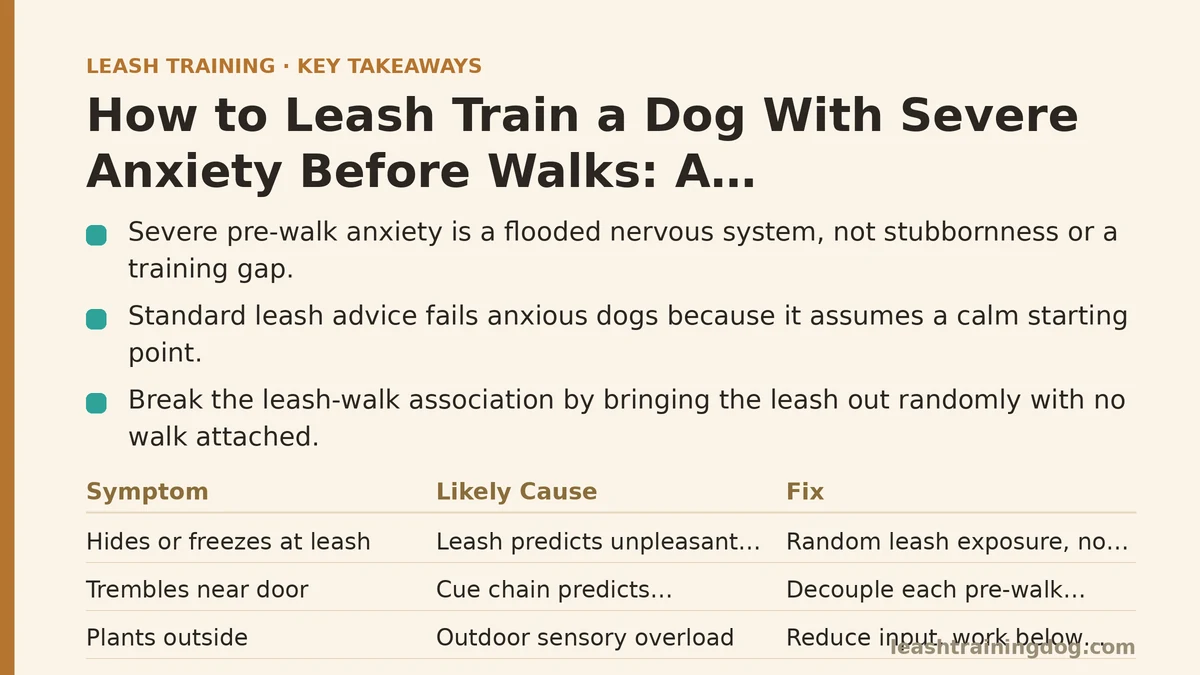
Severe pre-walk anxiety is not stubbornness, and it is not a training gap in the traditional sense. It is a body already flooded with stress hormones before the leash is clipped on. Standard leash training advice — walk more, be firm, push through it — tends to fail these dogs badly, because it assumes a calm starting point that simply does not exist.
What follows is organized differently from most leash guides. Instead of a linear program, treat this as a troubleshooting checklist. Find the symptom that matches your dog, understand what is driving it, and apply the fix. Most anxious dogs show two or three of these symptoms together, so do not be surprised if you need to work through several sections at once.
Symptom: Dog Hides, Freezes, or Disappears When the Leash Comes Out
You reach for the leash and your dog is suddenly under the bed, behind the couch, or pressed into a corner refusing eye contact.
Likely cause: The leash itself has become a predictor of something unpleasant — a rushed departure, an overwhelming outdoor environment, or simply the accumulated stress of dozens of walks that ended in panic. Dogs form these associations quickly and hold onto them for a long time, sometimes long after the original trigger is gone.
The fix: Break the association between the leash and the walk entirely, for now. Bring the leash out at random points during the day with no walk attached to it — drape it over furniture, hold it while you watch television, clip it on for ten seconds while feeding a treat, then remove it. The goal is a leash that predicts nothing in particular, sometimes good things, never anything scary. This takes one to two weeks of scattered, low-stakes exposure before you reintroduce the leash as part of an actual walk routine.
Symptom: Trembling, Panting, or Drooling Before You Reach the Door
The leash goes on without incident, but by the time you’re near the door, your dog is shaking, panting heavily in a cool room, or drooling in a way that has nothing to do with hunger.
Likely cause: This is a physiological stress response building in real time, not a behavioral choice. Something about the sequence — grabbing keys, putting on shoes, the sound of the door — has become part of a chain of cues that predicts the overwhelming event to come.
The fix: Slow the sequence down and decouple it. Practice the individual pieces — picking up keys, putting on shoes, touching the doorknob — without ever opening the door or attaching the leash. Reward calm body language after each step. Once your dog can sit through the full pre-walk routine without stress signs, add the leash back in as one more neutral step rather than the final cue for panic. Some dogs need this practiced for a week before any actual walk is attempted; that is a reasonable pace, not a slow one.
Symptom: Dog Plants and Refuses to Move Once Outside
The leash is on, the door is open, and your dog either won’t cross the threshold or takes a few steps and then stops dead, refusing to continue in any direction.
Likely cause: The outdoor environment itself — traffic noise, open sightlines, unfamiliar smells, other dogs in the distance — is more sensory input than the dog can process while also managing to walk normally. Planting is a freeze response, one of the core fear reactions alongside fight and flight.
The fix: Do not pull, coax with excessive treats toward the trigger, or pick the dog up and carry them forward — all three teach the dog that freezing gets managed for them rather than resolved. Instead, sit or crouch near your dog at the threshold and wait. Let them observe the environment from a stationary position until their body language softens even slightly — ears less pinned, tail less tucked. Reward that softening. Some sessions will only get as far as standing calmly on the porch. That is progress worth counting.
Symptom: Bolting Back Toward the Door or Trying to Escape the Harness
Once outside, the dog tries to physically retreat inside, backs out of the harness, or pulls hard toward the house rather than away from it.
Likely cause: This is an active attempt at flight, which tells you the dog has crossed from mild discomfort into a fear state strong enough to override normal impulse control. It usually means the walk was attempted at too much distance from safety, too fast, or in an environment with too many simultaneous triggers.
The fix: Shorten the walk to almost nothing. A walk can be five steps outside the door and back in, repeated daily, until five steps produces no attempt to retreat. Increase distance in small increments only after several consecutive calm sessions at the current distance. Check harness fit carefully — a harness that allows escape is often loose enough to also feel insecure to an anxious dog, which can itself increase the flight response.
Symptom: Anxiety Appears Only When Gear Goes On, Not Before
The dog is relaxed during normal pre-walk activity but becomes anxious specifically at the moment the collar or harness touches their body.
Likely cause: Handling sensitivity, sometimes from an uncomfortable or rushed past experience with gear, sometimes from insufficient early conditioning to being touched and restrained around the neck and shoulders.
The fix: Separate gear conditioning from walk conditioning completely. Practice touching the harness to the dog’s body, feeding a treat, and removing it — no walk follows. Gradually increase to buckling it fully, treating, then removing it again. Only once the harness itself produces a relaxed or neutral response should it be paired with a walk. This sounds slow. It usually takes less time than owners expect, often just three or four short sessions a day for under a week.
Symptom: Good Days and Terrible Days With No Clear Pattern
Some days the walk goes fine. Other days, with seemingly identical conditions, the dog is a wreck from the first step.
Likely cause: Anxious dogs carry a cumulative stress load, not a fixed baseline. A loud noise earlier in the day, a poor night’s sleep, a vet visit two days prior, or even weather changes can push a dog over threshold on a day that looks unremarkable from the outside.
The fix: Keep a simple log — date, time, what happened before the walk, how the walk went. Patterns tend to surface within two to three weeks that are not visible day to day. On days when a dog shows any pre-existing stress signs, shorten expectations for that walk rather than pushing through the planned distance. Flexibility here prevents a single bad day from becoming a setback that undoes weeks of progress.
Building the Pre-Walk Routine That Actually Helps
Once you have identified which symptoms apply, the underlying structure that helps almost every anxious dog is the same: predictability, small increments, and an exit available at every stage.
Keep the sequence leading up to a walk identical every single time for several weeks. Anxious dogs settle faster with routines they can predict than with routines that vary, even when the variation seems minor to you.
Never remove the option to retreat. A dog that knows they can go back inside if overwhelmed paradoxically becomes braver about staying out, because the environment feels less like a trap.
Keep initial walk sessions absurdly short. Two minutes in the front yard is a complete, successful walk for a severely anxious dog in the early stages. Length can increase once calm behavior is consistent, not before.
When to Bring in Professional Support
Severe pre-walk anxiety sometimes sits alongside broader anxiety disorders — generalized anxiety, noise phobias, or separation-related distress — that benefit from veterinary behavioral input rather than leash training alone.
Consider a referral if your dog shows anxiety symptoms unrelated to walks at all, if progress has stalled after four to six weeks of consistent, correctly paced work, or if the anxiety includes signs of self-injury such as excessive licking, skin damage, or destructive escape attempts. Anti-anxiety medication, used alongside the behavioral steps above, often shortens the timeline considerably for dogs whose baseline stress is too high for gradual exposure to gain traction on its own.
Quick Reference
| Symptom | Likely Cause | First Step |
|---|---|---|
| Hides from the leash | Leash predicts something bad | Decouple leash from walks |
| Trembling before the door | Stress chain building up | Slow and separate the routine |
| Planting outside | Sensory overload / freeze response | Sit and wait at the threshold |
| Bolting back inside | Active flight response | Shrink the walk to a few steps |
| Anxious only during gearing up | Handling sensitivity | Condition the harness separately |
| Unpredictable good/bad days | Cumulative stress load | Track patterns, adjust daily |
There is no shortcut through fear this deep, but there is a reliable path — smaller steps than feel necessary, repeated more patiently than seems reasonable, until the walk stops being an event the body has to survive.
Which of these symptoms matches your dog most closely, and how long has it been going on? Describe what you’re seeing and I can help narrow down where to start.
Related guides: How to Leash Train a Blind Dog: A Step-by-Step Guide, How to Leash Train a Rescue Dog With Unknown History: Myth vs Reality, and Leash Training for Dogs With Separation Anxiety: A Beginner Step-by-Step Tutorial.