Most people assume a rescue dog with no known history needs a completely different leash training method than a dog whose past you understand. That assumption is wrong. The mechanics of building a loose leash walk do not change based on what happened to a dog before you met them. What changes is your read of the dog’s reactions along the way, and how much patience the timeline requires.
People who have trained hundreds of rescue dogs over the years often find that those with blank-slate histories are not a different training category. They are the same training process wrapped in more uncertainty. The mistakes owners make with these dogs almost always come from myths about what “unknown history” means, not from the training itself being harder.
Below is a look at some of the most persistent myths rescue dog owners tend to hear, next to what tends to hold true after years of fitting leashes and walking these dogs professionally.
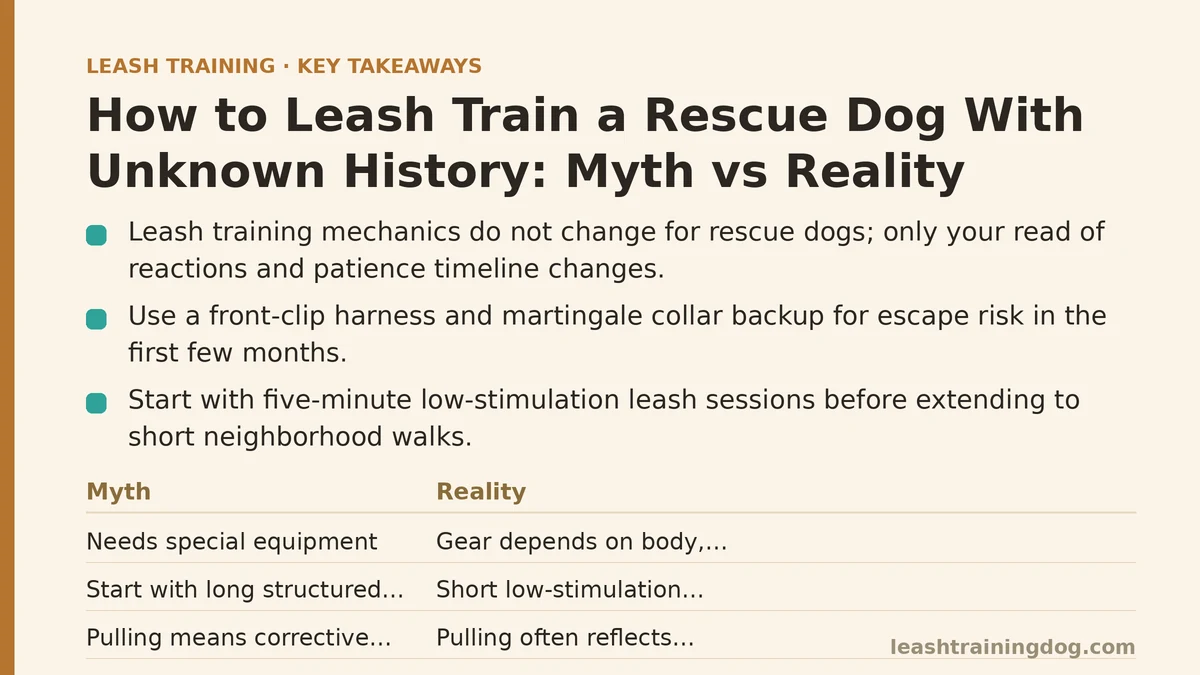
Myth: A Dog With Unknown History Needs Special Equipment
The myth: Owners often believe a rescue dog needs a heavier-duty harness, a specific “anxiety” leash, or some specialized product designed for traumatized dogs before any walking can happen.
The reality: Equipment needs for a rescue dog are determined by body shape, strength, and pulling tendency — the same factors that matter for any dog. What unknown history changes is not the gear itself but the fitting process. A well-padded, front-clip harness and a martingale collar as backup attachment points are recommended for nearly every rescue dog, regardless of their story, because escape risk is higher during the first few months in a new home.
A dog who slipped out of a previous life without warning may slip a collar just as easily in yours. Martingale collars tighten slightly under pressure and cannot be backed out of the way a flat collar can. This is not a special product for traumatized dogs — it is a sensible precaution for any dog whose flight response you have not yet observed.
Myth: You Should Start With Long, Structured Walks to Build Trust
The myth: A common piece of advice is to take a new rescue dog on a proper walk right away, sometimes a long one, on the theory that exercise builds trust and burns off anxious energy.
The reality: Long structured walks in the first week frequently backfire. A dog processing an unfamiliar environment, unfamiliar smells, and an unfamiliar handler is already managing significant sensory load. Adding distance and duration on top of that load tends to produce a dog who shuts down, drags, or becomes reactive to things that would not normally bother them.
I ask owners to spend the first several days doing short leash sessions in the yard or a quiet driveway — five minutes, no destination, just the dog wearing the leash and moving near the handler without pressure. The goal at this stage is not distance covered. It is the dog learning that the leash predicts nothing frightening. Only once a dog moves comfortably on leash in a low-stimulation space should you extend to short neighborhood walks, and even then keep the first two weeks short and repetitive rather than exploratory.
Myth: Pulling on Leash Always Means the Dog Needs Corrective Training
The myth: Owners frequently assume that a rescue dog pulling hard on leash is displaying dominance or a lack of respect, and that firm corrections will establish the right hierarchy quickly.
The reality: Pulling in a dog with unknown history is far more often a symptom of under-socialization to leash walking altogether. Many rescue dogs, particularly those from shelters, strays, or breeding facilities, have simply never worn a leash for any meaningful stretch of time. Pulling is not defiance — it is an unlearned skill meeting an overstimulating world.
Correction-based handling on a dog whose emotional baseline is already unstable tends to suppress the pulling temporarily while adding stress to an already stressed animal. This suppression can convert into fear-based reactivity within weeks. The better path is stop-and-reset training: the moment the leash tightens, you stop moving entirely and wait for slack before continuing. This teaches the mechanical lesson — tension stops forward progress — without adding any aversive pressure to a dog who may already be operating close to their coping limit.
Myth: You Need to Know a Dog’s Trigger History to Manage Reactivity
The myth: There is a widespread belief that you cannot properly manage or train around a dog’s reactive triggers unless you know exactly what caused the fear in the first place — a bad experience with a man in a hat, an attack by another dog, and so on.
The reality: Trigger origin stories rarely change the training plan. Whether a dog fears men in hats because of a specific incident or because of general under-socialization, the counter-conditioning process is identical: identify the threshold distance at which the dog notices the trigger without reacting, pair the trigger’s appearance with high-value treats, and gradually close the distance as the dog’s emotional response shifts.
What matters far more than history is careful observation in the present. Watch which triggers produce stiffening, freezing, or lunging. Note the distance at which each trigger stops bothering the dog. Track this over the first month, because it will tell you everything the missing paperwork cannot. A rescue dog’s behavior log, built from your own observations, is a better training tool than any shelter intake form.
Myth: Rescue Dogs Need Longer to Bond Before Training Can Begin
The myth: Owners sometimes hold off on any leash training for weeks, believing the dog needs to fully settle in and bond with the family before structured work can start.
The reality: Waiting too long to introduce gentle, low-pressure leash work can allow a dog to rehearse avoidance behaviors — bolting toward the door, freezing at the threshold — that then need to be unlearned later. Short, calm leash sessions from day two or three, kept well within the dog’s comfort zone, actually build trust faster than waiting, because they give the dog low-stakes, predictable interactions with the handler.
The decompression period recommended by most shelters — typically two to three weeks of minimal demands — applies to major changes like new training classes, dog parks, or boarding. It does not mean the leash stays in the closet. A dog wearing a leash indoors for ten minutes at a time while you go about normal activities is decompression-friendly. A trip to a crowded downtown sidewalk on day four is not.
Myth: A Dog That Shuts Down on Leash Is Being Stubborn
The myth: When a rescue dog plants their feet, refuses to move, or goes completely still on leash, many owners interpret this as stubbornness and try to physically coax or drag the dog forward.
The reality: Freezing on leash is almost always a fear response, not defiance — the canine equivalent of a system overload. Dragging a frozen dog forward tends to intensify the fear and can create a lasting negative association with the specific location or the leash itself.
When a dog freezes, I stop, crouch to the side rather than facing the dog directly, and wait. No pulling, no verbal pressure, just patience and occasionally a treat tossed a short distance in the direction you want to go, letting the dog choose to move toward it. This can take two minutes or twenty. The dog that chooses to move on their own terms recovers far faster than one who is physically moved against their will.
What Actually Matters More Than History
Since you cannot always access a rescue dog’s past, focus energy on what you can observe directly in the present:
Body language during the first walks tells you more than any adoption paperwork. A tucked tail, flattened ears, or a low, slow gait signals a dog operating in a stress state, regardless of what caused it.
Recovery time after a startle matters enormously. A dog that flinches at a passing truck and returns to normal within seconds is coping well. A dog that stays tense for the rest of the walk needs a slower introduction to that environment.
Consistency in your own handling replaces the consistency a known history would otherwise have taught the dog to expect. Dogs with uncertain pasts often benefit most from routines that are almost boringly predictable — same walking route, same time of day, same handler cues — because predictability itself is the trust-building mechanism.
| Myth | Reality |
|---|---|
| Needs special anxiety gear | Standard front-clip harness plus martingale collar for security |
| Long walks build trust fast | Short, low-stimulation sessions work faster |
| Pulling requires correction | Pulling usually means under-socialization to leash |
| Must know trigger origin | Present-day threshold distance matters more |
| Needs weeks before any training | Gentle leash work can begin within days |
| Freezing means stubbornness | Freezing is a fear response requiring patience |
A Realistic Timeline
Most rescue dogs with unknown histories show meaningful leash progress within four to six weeks of consistent, low-pressure work — provided the early sessions stay short and free of correction. Dogs carrying more significant fear responses, the ones who arrive flinching at every sound, may need three to four months before walks in moderately busy environments feel comfortable for them.
There is no shortcut that bypasses the dog’s own pace. The owners who see the fastest, most durable progress are the ones who treat the missing history as a reason for closer observation, not a reason for a different training system altogether.
Tell me what you have noticed in your rescue dog’s first few walks — freezing, pulling, bolting, or something else — and roughly how long you have had them, and I will help you figure out which myth might be shaping your current approach.
Related guides: Introducing a Rescue Dog to Leash Walking: A Beginner Step-by-Step Tutorial, How to Desensitize a Dog to a Leash for the First Time: Myth vs. Reality, and How to Leash Train a Dog With Severe Anxiety Before Walks: A Symptom-by-Symptom Fix Guide.