Say you are trying to walk your dog down a quiet street and a neighbor stops to say hello. Your dog’s front paws leave the ground before you have finished the word “sit.” The neighbor laughs it off, but you are the one holding a leash that just got yanked sideways, apologizing for muddy paw prints on someone’s jacket for the third time this month.
This is one of the most common walking complaints I hear from clients, and it is also one of the most fixable — provided you use a method that matches why the dog is jumping in the first place. Not every jumping dog is jumping for the same reason, and the ranking below reflects which methods work across the widest range of dogs versus which only work in narrow situations.
These five approaches are commonly used with clients over the years. Some work almost immediately. Others take real repetition. None of them involve yelling, kneeing the dog in the chest, or stepping on their back paws — all things I still see recommended online and none of which hold up to how dogs actually learn.
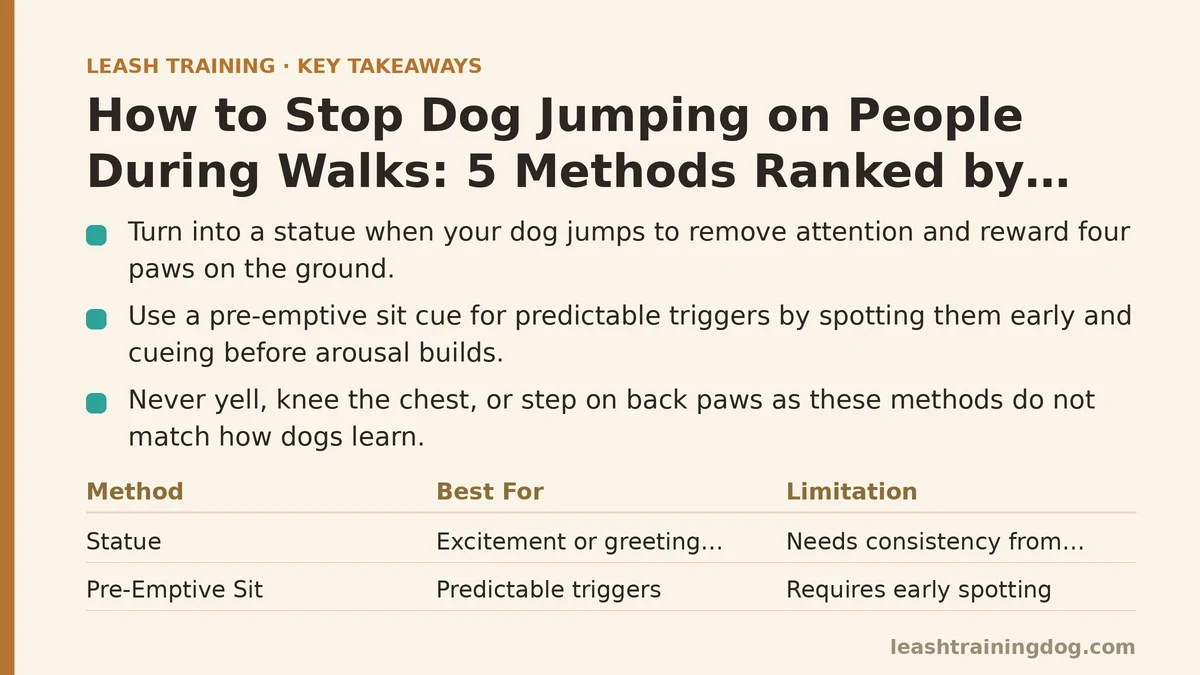
1. Turn Into a Statue (Best Overall Method)
This is the method to try first, because it requires no equipment, works on leash or off, and addresses the actual mechanism behind jumping: attention.
How it works: The moment your dog jumps — or even just before, if you can catch the wind-up — stop moving completely. Turn your body slightly away, cross your arms, look at the sky or the ground, and say nothing. No pushing the dog off, no “no,” no eye contact. All of that is attention, and attention is what the dog is jumping for in the first place.
The instant all four paws touch the ground, mark it with a calm “yes” and deliver a treat low, near the dog’s chest height, not up near your hands. The reward should never require the dog to reach upward for it.
Why it ranks first: It removes the reinforcement for jumping (attention) while immediately rewarding the alternative (four paws down). Most dogs figure out the pattern within ten to fifteen repetitions across a few days.
Best for: Dogs jumping out of excitement or greeting behavior — the majority of walking-related jumping cases.
Limitations: Requires consistency from everyone the dog encounters, including strangers who want to pet an excited dog. One person laughing and petting the dog mid-jump can undo several correct repetitions.
2. Pre-Emptive Sit Cue Before Contact (Best for Predictable Triggers)
If your dog jumps at the same predictable moments — the same neighbor on the same corner, the same delivery driver, the mail carrier — this method works faster than the statue technique because you are intercepting the behavior before it starts.
How it works: As soon as you spot the trigger approaching, well before your dog is close enough to jump, cue a sit. Reward generously for holding the sit as the person gets closer. If the dog breaks the sit to jump, the person stops approaching and steps back a few paces until the dog resets.
Why it ranks second: It is highly effective for known, repeatable triggers, but it depends on you spotting the trigger early enough to cue the behavior before arousal builds. A dog that is already at full excitement when you notice the trigger is much harder to redirect.
Best for: Dogs with a short list of predictable jumping triggers — familiar neighbors, regular walking routes, the same dog-walking friend twice a week.
Limitations: Less useful for dogs that jump on unpredictable strangers, since you need advance warning to set the cue up properly.
3. The Leash-Step Method (Best for Strong, Determined Jumpers)
For dogs whose jumping is powerful enough to knock people over — larger breeds especially — sometimes a small physical management tool helps while the training above takes hold.
How it works: Step on the leash near the clip, leaving just enough slack for the dog to stand and sit comfortably but not enough to jump upward. This is not a correction; it is a physical limit that prevents rehearsal of the jump while you reward calm behavior. Combine this with the statue method — reward heavily for paws staying down, ignore the dog straining against the slack.
Why it ranks third: It prevents the behavior effectively in the moment, which matters for safety with large dogs, but it does not teach the dog anything on its own. Without pairing it with reinforcement for calm behavior, the dog simply resumes jumping the moment the leash slack increases.
Best for: Large or strong dogs where jumping poses a real physical risk to smaller adults, children, or elderly neighbors.
Limitations: A management tool, not a training solution. Needs to be paired with one of the reinforcement-based methods above to produce lasting change.
4. Structured Greeting Protocol (Best for Social, People-Loving Dogs)
Some dogs jump specifically because they love people and have never been taught what an acceptable greeting looks like. For these dogs, teaching a replacement behavior works better than simply withholding attention.
How it works: Teach a hand-target or a sustained sit as the “greeting behavior.” Practice this at home first, then with a helper who approaches slowly and rewards the sit generously. Once reliable at home, generalize it to real walks — a friend, then a stranger who has been asked in advance to only greet if the dog stays seated.
Why it ranks fourth: It works well but takes more setup than the first two methods. It requires cooperative people willing to follow your instructions, which is not always available with a stranger on a sidewalk.
Best for: Friendly dogs who jump purely from excitement to greet, especially dogs that already know a solid sit-stay in low-distraction settings.
Limitations: Slower to generalize to novel people compared to methods that do not depend on a helper’s cooperation.
5. Front-Clip Harness or Head Collar for Added Control (Best as a Supplement)
I am including this fifth option because it comes up often, but it belongs at the bottom of this list for a reason: it manages the physical outcome without addressing why the dog jumps.
How it works: A front-clip harness redirects the dog’s forward momentum sideways when they lunge toward a person, which reduces the height and force of the jump. It does not stop the dog from wanting to jump — it just makes the physical act harder to complete successfully.
Why it ranks fifth: On its own, this changes very little about the dog’s underlying excitement or attention-seeking motivation. Dogs can adapt around the harness mechanics over time if the harness is used as a standalone fix rather than alongside training.
Best for: A supporting tool for large dogs during the training window, not a stand-alone solution.
Limitations: Does not teach an alternative behavior. Should always be paired with one of the four training methods above.
Why Yelling and Physical Corrections Don’t Work Here
I want to address this directly because it is still common advice: kneeing a jumping dog, stepping on their back feet, or shouting “off” at the top of your voice.
These methods sometimes suppress jumping temporarily because the dog associates the specific handler with pain or startlement. They rarely change the dog’s underlying excitement around greeting people, and the behavior tends to return — often directed at other people who have never applied the correction, since the suppression was tied to the person, not the behavior itself.
Worse, physical corrections during greetings can create a negative association with approaching people at all, which sometimes shows up later as hesitance or even defensive behavior around strangers. That trade is not worth it when a calm, attention-based method solves the same problem without the risk.
Building the Full Plan
Most dogs respond best to a combination rather than a single method used in isolation. Here is how I typically sequence it with clients:
| Situation | Primary Method | Supporting Method |
|---|---|---|
| General excitement jumping | Statue technique | Structured greeting protocol |
| Predictable trigger (same neighbor, same corner) | Pre-emptive sit cue | Statue technique |
| Large or strong dog, safety concern | Leash-step management | Front-clip harness |
| Dog loves people, lacks greeting manners | Structured greeting protocol | Statue technique |
Start with whichever method fits your dog’s specific pattern, and give it at least two full weeks of consistent practice before deciding it is not working. Jumping behavior that has been rewarded with attention for months or years does not disappear in a single walk, no matter how correctly you apply the technique.
What Progress Actually Looks Like
The first sign of change is usually not the absence of jumping — it is a hesitation. A dog that used to launch immediately starts to pause, glance at you, and offer a half-sit before deciding whether to jump anyway. That pause is the moment your training is reaching them, and it is worth rewarding heavily even if the sit does not stick every time yet.
Full reliability, where your dog greets every stranger with four paws down, tends to take four to eight weeks of consistent practice for moderate jumpers and longer for dogs with a long-standing habit or particularly high arousal around people.
Tell me your dog’s size, how long the jumping has been going on, and whether it happens with everyone or just certain people — I will help you figure out which method from this list fits your situation best.
Related guides: How to Calm an Overexcited Dog on the Leash: A Step-by-Step Guide, How to Keep Your Dog Calm at the Dog Park Entrance on Leash, and Teaching Your Dog to Wear a Muzzle During Leash Walks: Step-by-Step.