A sighted dog on leash is reading the environment constantly — watching for other dogs, gauging distance to the curb, adjusting stride before an obstacle even comes close. A blind or visually impaired dog on leash is reading you. That single difference changes almost everything about how the leash should be introduced, held, and used.
Owners often assume the training process is the same, just slower or more patient. It is not the same process. It is a different one, built around senses the dog still has full access to — hearing, smell, touch, and the vibration of the ground through their paws. Get the sequence right and a blind dog can walk as confidently as any sighted dog. Get it wrong, and you end up with a dog that freezes at the door, refuses to move past three meters, or startles at every unexpected touch.
Below is a step-by-step sequence for working with dogs who are fully blind, partially sighted, or losing vision gradually due to age or degenerative conditions.
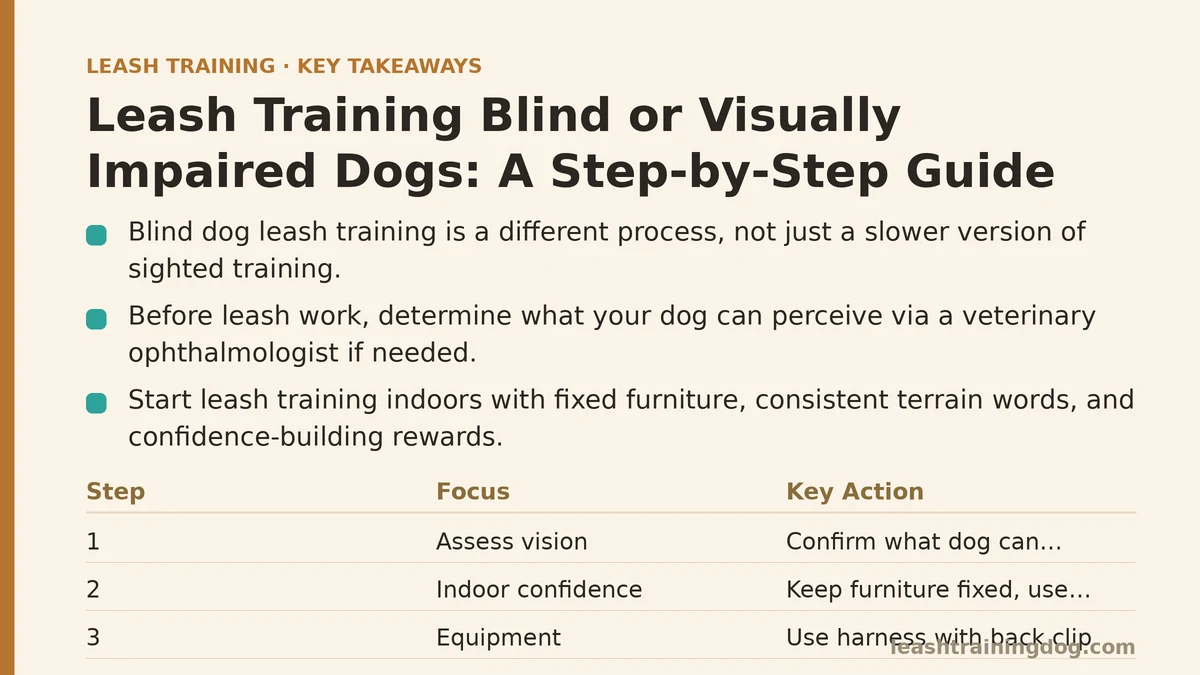
Step 1: Confirm What Your Dog Can Actually Perceive
Before any leash work begins, figure out what your dog’s world currently looks like.
Dogs losing vision gradually — from progressive retinal atrophy, cataracts, or age-related decline — often retain some light perception or peripheral movement detection long after detailed vision is gone. A dog with SARDS or a sudden retinal event may have gone from fully sighted to completely blind within days, which carries a different emotional adjustment than a slow decline.
Watch your dog in a quiet, familiar room. Roll a soft ball across the floor a few feet away and note whether their head tracks it. Dim the lights gradually over a few evenings and watch for hesitation on stairs or furniture edges — this often reveals night blindness before full blindness is diagnosed. If you have any doubt, a veterinary ophthalmologist can confirm the degree and type of vision loss, which matters because a dog with some peripheral light perception benefits from different cues than a completely blind dog.
This assessment shapes every step that follows, so it is worth doing properly rather than guessing.
Step 2: Rebuild Confidence Indoors First
Leash training a blind dog does not start at the front door. It starts in the living room.
A dog who has recently lost vision is often disoriented in spaces they used to navigate easily. Before adding a leash and an unfamiliar outdoor environment, spend several days letting your dog re-learn confident movement indoors. Keep furniture in fixed positions — this is not a temporary suggestion, it is a permanent rule for the household going forward, since blind dogs build detailed mental maps of stable environments.
Use a consistent word paired with any change in terrain — “step” for a stair or threshold, “careful” for a low obstacle — so these words carry meaning before you ever need them outside. Reward calm, exploratory movement with your voice and small treats. The goal at this stage is not obedience. It is restoring the dog’s basic trust that moving forward is safe.
Step 3: Choose Equipment That Communicates, Not Just Restrains
The right gear matters more for a blind dog than for almost any other training scenario, because equipment becomes a communication channel rather than just a safety measure.
A well-fitted harness with a back clip is usually preferable to a collar for blind dogs, since sudden collar pressure near the head and neck can startle a dog who did not see a correction coming. Choose a harness with a handle on top — this lets you physically guide your dog around an obstacle with a gentle upward lift rather than relying on leash pressure alone, which a blind dog interprets less precisely than a sighted one.
Many trainers now recommend a “blind dog” vest or bandana in bright yellow, since it signals to other people and off-leash dogs to approach with caution. This does not train your dog directly, but it reduces the number of startling surprises — an off-leash dog running up unannounced — that can undo weeks of progress in a single encounter.
A leash between four and six feet gives enough length for natural movement without so much slack that your dog outpaces your ability to warn them of hazards.
Step 4: Introduce a Verbal Cue System Before You Leave the House
Blind dogs rely heavily on verbal cues to compensate for the visual information they cannot gather themselves. Build this vocabulary indoors, where mistakes are low-stakes, before testing it outside.
At minimum, most blind dogs benefit from a cue for stepping up, stepping down, stopping, and turning. Something like “up” for a curb or stair going up, “down” for a step going down, “wait” for a full stop, and a direction word — “left” or “right” — paired with a gentle guiding motion on the leash as you turn.
Practice each cue dozens of times in low-stakes settings before pairing it with an actual obstacle outdoors. A dog that has heard “wait” reliably followed by a full stop and a treat, fifty times over, will respond far more reliably to that same cue at the edge of a real curb with traffic passing.
Step 5: Take the First Outdoor Walk in a Completely Familiar, Low-Stimulation Space
The first outdoor leash walk should happen somewhere your dog already knows by scent — their own yard, a quiet stretch of sidewalk they have walked before losing vision, or a familiar neighbor’s garden.
Walk at a slower pace than you would with a sighted dog and narrate the environment quietly and consistently: “curb up,” “grass ahead,” “turning left.” Dogs pick up on tone and rhythm even before they fully understand the words, so a calm, steady voice does a lot of the reassurance work in these early sessions.
Keep the first few walks short — five to ten minutes — and end them before your dog shows signs of fatigue or overstimulation. A short, calm, successful walk builds more confidence than a long walk that ends in a stressful stumble.
Step 6: Layer in New Environments Gradually
Once your dog is walking confidently and responding to your cues in the familiar space, begin introducing small variations — a different route around the same block, a park with a slightly different texture of ground, a quiet street with light foot traffic.
Change one variable at a time. If you introduce a new surface texture, keep the route otherwise identical. If you introduce a new route, keep it at a familiar time of day when noise and foot traffic are predictable. Blind dogs generalize more slowly than sighted dogs because they cannot visually confirm that a new environment is safe the way a sighted dog can with a quick glance around. Patience at this stage prevents setbacks later.
A dog that handles three or four varied environments confidently over several weeks is ready for busier settings — but rushing this step is the most common mistake I see with well-meaning owners eager to resume normal walking routines.
Step 7: Manage Encounters With Other Dogs and People Proactively
A blind dog cannot see another dog approaching and prepare emotionally the way a sighted dog can. This means startle reactions — including defensive snapping from otherwise friendly dogs — are more common and should be anticipated rather than treated as a training failure.
Give wide berth to approaching dogs by default, and use a verbal heads-up cue — something like “dog coming” — paired consistently with treats, so your own dog learns that the announcement predicts something manageable rather than something threatening. Ask other owners to keep their dogs at a distance and, where relevant, mention that your dog is blind before any greeting is attempted. Most people are accommodating when they understand the situation, but they need to be told before the dogs are close enough for a startled reaction.
Step 8: Build a Long-Term Routine That Keeps Working as Vision Changes
For dogs with progressive vision loss, the training process does not end once initial confidence is established. Vision may continue to decline, and the routine needs to flex with it.
Keep environments and furniture layouts stable at home permanently, not just during initial training. Continue using the verbal cue system on every walk, even once your dog seems to be navigating well — the cues remain the primary tool your dog has for anticipating change. Revisit the confidence-building steps above any time vision noticeably worsens, since a dog adjusting to a new stage of vision loss benefits from the same patient, low-stimulation reintroduction as a newly blind dog.
| Stage | Focus | Typical Duration |
|---|---|---|
| Indoor confidence rebuilding | Trust, verbal cue foundation | 1–2 weeks |
| Equipment introduction | Harness, handle, leash familiarity | 3–5 days |
| First outdoor walks | Familiar, low-stimulation routes | 1–2 weeks |
| Environment expansion | New routes and surfaces, one variable at a time | 3–6 weeks |
| Ongoing management | Ongoing cue use, encounter management | Lifelong |
The Bottom Line
Leash training a blind or visually impaired dog is not a shorter or simpler version of standard training — it asks more of the handler, not less. Your voice, your consistency, and your willingness to narrate the world become the tools your dog relies on in place of their eyes.
Done patiently, this process produces dogs that walk with real confidence, not just tolerance of the leash. The destination looks the same as it does for any well-trained dog. The path there is simply guided by different senses.
Tell me whether your dog is fully blind or partially sighted, how recently the vision changed, and what part of the walk currently causes the most hesitation — I will help you figure out where to start.
Related guides: Leash Training Deaf Dogs: What You Need to Know, How to Leash Train a Blind Dog: A Step-by-Step Guide, and Leash Training for Dogs With Separation Anxiety: A Beginner Step-by-Step Tutorial.