Seventy percent of dogs in apartments under 800 square feet have owners who believe the same myth: that loose-leash walking requires a large yard or a quiet suburban street to practice on. That belief is wrong. In practice, the apartment environment — with its narrow hallways, elevator doors, and unexpected neighbors — provides a more effective training arena than a fenced lawn ever does. The confinement forces you to address the two things that matter most: impulse control at close quarters and calm behavior around sudden triggers. You do not need space to train loose-leash walking. You need a plan that turns every step from your door to the sidewalk into a mini-session.
Below is a five-step sequence that works specifically within the constraints of apartment living. Each step builds on the last, and each one can be done in a hallway, a stairwell, or a tiny living room. By the end, you will have a dog that walks politely from your front door to the elevator, across the lobby, and into the outside world — without dragging you toward the nearest scent or lunging at a neighbor.
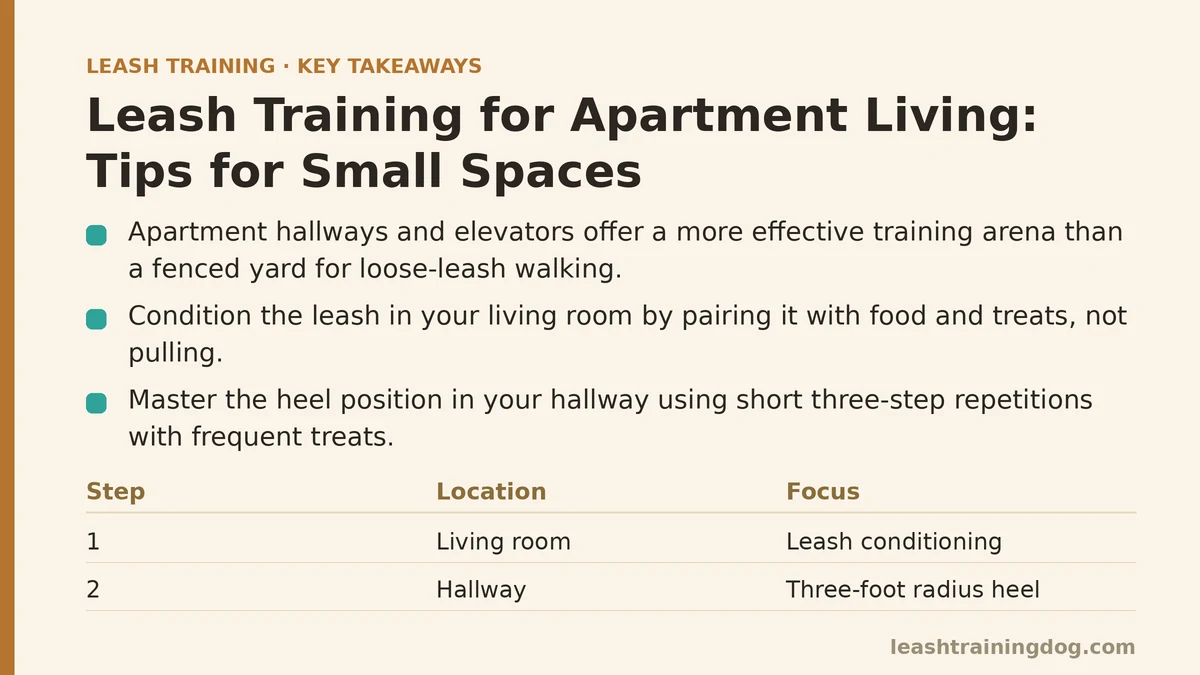
Step 1: Condition the Leash in Your Living Room (Days 1–3)
Before your dog associates the leash with walks, they must associate it with something pleasant. In a small space, this is easier than you think.
Pick a 10-by-10-foot area of your living room — clear away obstacles if you can. Clip on the leash and let it drag freely for the first session. Scatter a handful of your dog’s regular kibble on the floor. Let them find it. Do not hold the leash. Do not call them. Just let the leash exist in the same space as food.
After two or three sessions of this, pick the leash up. Hold it loosely and follow your dog around the room as they sniff and explore. Every time they look back at you while you hold the leash, mark with a word like “yes” and drop a high-value treat (small pieces of chicken or cheese work best). This teaches them that pressure on the leash means nothing bad, and that checking in with you produces rewards.
Why this matters in an apartment: The biggest predictor of pulling is the dog’s emotional response to the leash itself. Dogs that have only ever felt the leash when it yanks them away from something learn to brace against it. Dogs that feel it while receiving treats learn to move with it. You cannot do this work in a park — there are too many distractions. The living room is the perfect classroom.
Signs it is working: Within three days, when you pick up the leash, your dog should show happy body language — tail wagging, soft eyes, maybe a play bow. If they stiffen or freeze when the leash clips on, keep doing leash-conditioning sessions only, no walks, until that response shifts.
Step 2: Master the Three-Foot Radius in Your Hallway (Days 4–7)
Your apartment hallway is a training tool most suburban owners never get: a long, narrow, low-distraction corridor perfect for teaching heel position.
Start at your apartment door. Give your dog the command to heel (or simply lure them with a treat at your left hip). Close the door, take three steps down the hallway, stop, and treat. Take three more steps, stop, treat again. You are building the pattern: walking next to your hip for short distances equals frequent rewards.
The key variable is duration, not distance. Your hallway might only be 30 feet long — that is fine. Ten focused repetitions of three steps with a treat at each stop teaches more than one lap around a block without treats. Keep each repetition under 30 seconds, and end the session before your dog loses interest. Three sessions per day, five minutes each, is enough at this stage.
Common mistake and fix: Most owners rush past the doorway, which for an apartment dog is the single most exciting moment of the entire walk — the threshold between inside and outside. Your dog starts pulling at the front door, not at the park. Spend the entire first session of Day 4 working within five feet of your door: door opens a crack, treat; door opens fully, treat; step over the threshold, treat; step back inside, treat. Repeat ten times before you attempt the hallway.
Why this works in small spaces: A three-foot radius around your body is all the space you need to practice the loose-leash footwork. The apartment hallway removes visual distractions, so your dog can focus entirely on you. This is a luxury you will not have outside, where cars, bikes, and other dogs compete for attention.
Step 3: Add Real-Life Distractions — The Elevator and Lobby (Days 8–14)
Once your dog walks calmly for three to five minutes in the hallway at your side, it is time to slowly introduce the apartment building’s real-world triggers.
Break this into three sub-progressions, each taking two or three days:
Elevator door: Stand 10 feet away from the elevator doors while they open. If your dog stays sitting and looking at you, treat. Close the doors, repeat. Once they can remain calm through ten door openings, move to standing just outside the elevator. Then step inside for two seconds, treat, step out. Build to a full ride down one floor and back up.
Lobby: The lobby of an apartment building is a rich environment — mailboxes, package deliveries, other residents entering and exiting. Start by walking your dog into the lobby for one minute, then returning to the hallway. Keep the session short and treat-heavy. Over three days, increase the time until you can circle the lobby area without pulling.
Neighbor encounters: This is the most difficult trigger for apartment dogs because you cannot control who appears. The fix is the same as the hallway work, but with distance management. The moment you see a neighbor, call your dog to your side, turn 90 degrees so the neighbor passes at a wider angle, and feed treats as they walk by. If your dog explodes, you are too close — increase the angle or walk back toward your apartment until they begin to calm, then resume the approach.
Signs it is working: Your dog offers you attention — a glance or a sit — when a neighbor appears, rather than staring hard at them. You should get through a full lobby crossing without more than one or two mild pulls that self-correct within a second.
Step 4: Build Distance Outside — The First 50 Meters (Days 15–21)
The transition from lobby to sidewalk is where most apartment dogs fall apart, because suddenly the environment expands in every direction. The solution is to shrink it again.
For the first week of outside walks, restrict yourself to a 50-meter radius from your building entrance — the same few blocks in each direction, walked back and forth. This is not a walk in the traditional sense; it is a series of three-minute loops designed to reinforce the loose-leash pattern you built inside.
Use a simple rule: when the leash is loose, you move forward. When the leash is tight, you stop completely and wait. Do not yank, do not turn, do not respond to whining. Wait until your dog takes a single step back toward you, releasing the tension, then mark and move. If you have practiced the hallway work with the three-step pattern, your dog already knows the solution: walking beside you produces forward movement and treats. The outside just tests whether that learning transfers.
Keep walks to 10 minutes maximum at this stage. Longer walks flood the nervous system with too many triggers, especially in an apartment context where your dog has already processed an elevator ride, a lobby crossing, and a staircase before reaching the sidewalk. Ten good minutes beats 30 minutes of pulling and yanking.
Step 5: Manage Thresholds and Energy Inside the Apartment (Ongoing)
The single biggest mistake apartment owners make is treating home as a calm zone and outside as the only place training happens. In small spaces, the apartment itself is the training ground, because that is where your dog’s arousal state gets set.
Three rules to apply from day one and continue indefinitely:
Rule 1: No door-darting ever. Every single exit — front door, fire escape, elevator — is a training opportunity. Your dog must sit and wait before the door opens, before you step through, and before they step out. If they dart, close the door gently and reset. Repeat until they wait at least ten seconds. This one rule eliminates 50 percent of loose-leash problems before they begin.
Rule 2: Use the apartment for arousal control. Dogs that live in small spaces need more structured mental exercise, not less. Five minutes of impulse-control games — a sit-stay while you count to ten, a touch-your-hand command, a loose-the-leash game where they walk beside you across the room — tires a dog more than a 20-minute walk does. In an apartment, you cannot rely on physical space to burn energy, so you must substitute mental engagement.
Rule 3: End every walk with a calm decompression. The last two minutes of any walk should be slow walking at your side, not sprinting toward the building. When you enter the lobby, reduce your pace. When you get to the apartment, have your dog sit at the door while you unlock it. This prevents the “wound up from the walk” state that leads to zoomies in small spaces and trashes your training progress. A calm entry sets the tone for the next walk.
Quick Reference: Apartment Leash Training Checklist
| Stage | Where | Duration | Key Goal | Success Metric |
|---|---|---|---|---|
| Step 1 | Living room | Days 1–3 | Leash = positive association | Happy body language when leash clips on |
| Step 2 | Hallway + doorway | Days 4–7 | Loose-leash at your side | 3 steps between treats, 10 reps per session |
| Step 3 | Elevator + lobby | Days 8–14 | Calm under distractions | Stays calm through 10 door openings |
| Step 4 | Outside, 50-meter radius | Days 15–21 | Loose-leash transfers outdoors | 10-minute walks without pulling |
| Step 5 | Apartment, ongoing | Continuous | Arousal control at thresholds | Sit-wait at every door, calm entry |
The One Practice That Makes Apartment Training Unfairly Simple
If you only take one thing away, take this: in an apartment, the leash is never just a walking tool. It is a communication device you are using in every room, every doorway, and every elevator ride. When you treat the leash as something that connects you to your dog’s attention rather than a restraint system, the small space becomes an advantage rather than a constraint.
Start today with Step 1 — ten minutes of leash conditioning in your living room. Do that before your next walk, and you will see a difference in how your dog responds to the leash within 48 hours.
What size is your apartment and what is your dog’s most challenging indoor trigger — the front door, the elevator, or the lobby? Leave a comment and I will give you a specific modification to the steps above.
Related guides: Puppy Walking Mistakes That Create Lifelong Leash Pulling, Night Walk Safety Tips for Leash Training Your Dog: A Step-by-Step Guide, and Best Treat Pouches for Hands-Free Leash Training: A Q&A Guide.