Walking one dog that pulls is annoying. Walking four that pull in different directions is a shoulder injury waiting to happen. The confusion most walkers and sitters run into is treating a group walk like a scaled-up version of a solo walk — same technique, more leashes. It is not. Group leash management is a different skill with different rules, different equipment, and a different definition of a successful outing.
This guide is structured as a troubleshooting reference. Find the symptom that matches what you are dealing with on your current route, read the likely cause, and apply the fix. Not every symptom will apply to every group, and that is fine — most walkers only need three or four of these solved to make their daily rounds dramatically more manageable.
Symptom: The Whole Group Surges the Moment You Step Outside
Likely cause: You are leaving the door with all dogs already clipped on, already excited, and already feeding off each other’s arousal. The walk begins at a 9 out of 10 energy level, and you spend the first ten minutes compensating.
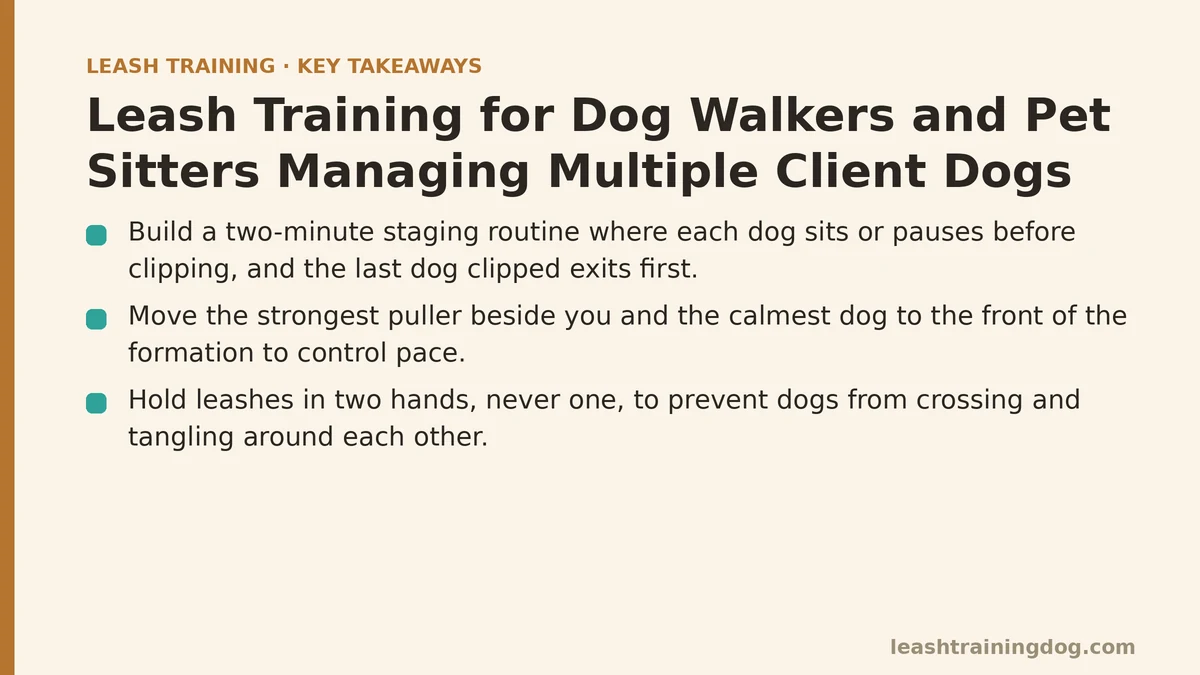
The fix: Build a two-minute staging routine before the door opens. Clip one dog at a time, and require a sit or a stationary pause from each dog before you move to the next. The last dog clipped is the first one out, so the dog who is hardest to manage gets you closest and freshest. Do not open the door until every dog is standing still, even if only for three seconds. That single change commonly reduces the first-block chaos by half.
If you have more than four dogs: Split the group into two staging positions — two dogs on your left, two on your right — so you are never reaching across one dog to clip another. Reaching across a charged dog is how bites happen to handlers, not the dogs.
Symptom: One Dog Pulls Constantly and Drags the Whole Line Forward
Likely cause: The pulling dog has learned that forward motion is the reward, and in a group setting the other dogs reinforce it because stopping means the group stops. You are outnumbered.
The fix: Move the strongest puller to a position beside you rather than in front, and put the calmest dog at the front of the formation. A dog that pulls at the front sets the pace for everyone behind. A dog that pulls at your side has nowhere to drag you — you are the anchor.
Pair this with a front-clip harness for that specific dog. A front-clip design redirects pulling force sideways rather than letting the dog lean into the leash, which is why it is the standard recommendation for strong pullers. You can read a detailed comparison in our guide to the best harness for dogs that pull.
If the pulling does not improve after two weeks: Consider whether that dog needs solo walks for a while. Some dogs cannot learn loose-leash skills in a group because the arousal level is permanently too high. A brief solo period, then reintroduction, often works faster than fighting it in the group every day.
Symptom: Two Dogs Keep Wrapping Leashes Around Each Other
Likely cause: You are holding all leashes in one hand, which allows dogs on opposite sides to cross in front of you and tangle. Tangles are not just irritating — they are a safety risk, because a dog that bolts mid-tangle can pull another dog down.
The fix: Hold your leashes in two hands, never one. Dogs that walk well go on your left hand; dogs that need more active management go on your right. Keep a minimum 1.5-meter separation between any two dogs on the same side by adjusting leash length, not by pulling the dogs apart.
| Number of Dogs | Recommended Setup | Leash Handling |
|---|---|---|
| 2 dogs | One per hand | Separate hands always |
| 3 dogs | Two left, one right | Strongest puller on right |
| 4 dogs | Two per side | Longest leashes on calmest dogs |
| 5+ dogs | Split into two walks | Do not attempt single-handler groups this large |
Recovery if a tangle happens anyway: Stop walking immediately. Do not try to untangle while moving. Have the group stand, lower your hands, and untangle from the ground up rather than reaching over dog heads. Reaching over a dog’s head to fix a leash is one of the most common ways walkers get nipped.
Symptom: One Client Dog Is Reactive to Other Dogs, and the Group Sets It Off
Likely cause: A reactive dog in a group is being asked to hold its composure while surrounded by other dogs it is already stimulated by. The threshold for a reaction drops substantially in that environment compared to a solo walk.
The fix: A reactive dog should not be walked in a group with unfamiliar or high-energy dogs, full stop, unless a qualified trainer has specifically cleared it. This is not a leash-handling problem you can out-technique. If you must walk that dog on the same route as other clients, stagger the walks — reactive dog first, alone, then the group.
If the owner pressures you to include the dog in group walks: Explain the liability plainly. A reactive dog that bites another client’s dog while in your care puts you in the middle of two insurance claims and two unhappy owners. Most owners accept this when it is framed as protecting their dog, not excluding it. If they do not, that client is often not worth the risk.
Symptom: You Cannot Physically Hold the Leashes Safely Anymore
Likely cause: You have taken on more dogs than one person can safely manage. This is not a training failure — it is a capacity problem.
The fix: Use the two-finger test on your own grip. If you cannot hold a leash with two fingers wrapped around it while a dog pulls moderately, the setup is beyond safe handling. Walkers commonly cap themselves at four to six dogs total, but that number depends heavily on the dogs’ sizes, ages, and temperaments. Four calm senior dogs is not the same job as four adolescent huskies.
A practical capacity guide to apply to your own route:
- Total combined weight of dogs should not exceed roughly what you can control with one hand if the group suddenly lurches
- Any dog over 40 kilograms counts as two dogs toward your limit
- Any dog under one year old counts as two dogs, because impulse control is not yet reliable
- Any dog with a known reactivity history counts as three dogs, or should be walked solo
If your route exceeds these rough thresholds, the correct response is to raise your rate and lower your client count, not to push through and hope nothing goes wrong.
Symptom: The Dogs Are Fine on the Walk but Chaos Erupts at Drop-Off
Likely cause: The walk ends with a race to the door, and the arousal spike at the end undoes the calm you built during the walk. Owners also tend to greet their dogs at a high energy level, which amplifies it.
The fix: Build an end-of-walk ritual. Thirty meters before the client’s door, slow the group to a stop. Bring the drop-off dog to a stationary position beside you. Only then approach the door. Ask the owner, politely, to wait for the dog to be stationary before greeting it. This is not about strict obedience — it is about keeping the last thirty seconds of the walk from becoming the most exciting part, which trains the opposite of what you want.
If the owner insists on a big greeting: That is their call, but point out that it makes the dog harder to walk for the rest of the route if you have other dogs still on board. Most owners adjust once they understand that the greeting affects the other dogs on your schedule, not just their own.
Symptom: A New Dog in the Group Disrupts Everyone Else
Likely cause: The new dog has not been introduced to the group on neutral ground, and the existing dogs are reacting to a stranger in their walking routine.
The fix: Introduce new dogs one at a time, on neutral ground, before adding them to the group route. A ten-minute parallel walk with the new dog and the calmest existing dog, at 5 to 10 meters of distance, is usually enough for a first assessment. If either dog fixates, stiffens, or refuses to move, the pairing is not ready and should be tried again on a different day.
Watch for these signs that the pairing will not work in the group: hard staring, raised hackles held for more than a few seconds, a tucked tail combined with refusing to walk forward, or any attempt to block the other dog’s path. One of those signs is a caution; two or more means do not put them in a group together yet.
Symptom: A Client’s Dog Behaves Worse for You Than for the Owner
Likely cause: The dog has not generalized leash manners to different handlers. This is common and not a reflection of your skill. Dogs learn cues tied to specific people, voices, and routines.
The fix: Ask the owner which exact words and hand signals they use, and use the same ones verbatim for the first few weeks. Matching the owner’s cues is faster than teaching a new set. Once the dog is reliable with the owner’s cues under your handling, you can introduce your own consistent phrasing, but only one variable at a time.
A note on equipment handoff: If the owner uses a particular harness, collar, or leash setup, use it as provided unless there is a clear safety problem. Switching equipment between walks confuses the dog and creates liability ambiguity if something goes wrong. If you believe different equipment is needed, raise it with the owner as a specific recommendation — not as a unilateral change.
A Pre-Walk Checklist You Can Use Today
Before heading out with any group of client dogs, run through these five checks. It takes under a minute and prevents most of the situations described above.
- Every dog is clipped on and the leash is tested with a gentle tug before the door opens
- Strongest puller is positioned on your right, calmest dog in front
- Leashes are in two hands, not one
- Reactive or new dogs are on a route that avoids known triggers (other dogs, squirrels, delivery trucks)
- You know which client dog gets dropped off first, and the approach to that door is planned
If you cannot tick all five, do not leave yet. A minute of staging beats twenty minutes of untangling.
When to Involve a Professional Trainer
Not every problem in this guide is a leash-handling problem you can solve alone. Bring in a certified trainer or behavior consultant if any of the following apply:
- A dog has bitten, snapped at, or lunged at another dog or a person during a group walk
- A dog shows signs of severe anxiety on every walk regardless of setup (freezing, drooling, refusing to move)
- You have adjusted positioning, equipment, and group composition for three weeks with no improvement
- The owner reports the dog behaves well at home but is unmanageable in any group setting
A veterinarian or veterinary behaviorist may also be warranted if the anxiety or reactivity appears sudden, or if the dog’s behavior changed alongside any physical symptoms. Behavior problems and medical problems overlap more often than owners expect.
What to Do Next
Pick the single symptom on this list that matches your most difficult client dog right now. Apply the corresponding fix for one full week before changing anything else. Walkers commonly find that solving one symptom — usually the pulling dog or the leash-tangle problem — improves the entire route, because problems compound on each other.
If you are taking on new clients this month, use the capacity guide above and raise your rate rather than your dog count. The walkers who last in this work are the ones who treat their own safety and their dogs’ calm as the priority, not the number of stops on the schedule.
If you are new to structuring leash work in general, our guide to teaching recall to your dog covers the foundation skills that make group walking easier, and our breakdown of leash training around distractions addresses the specific challenge of walking where other dogs and people are constantly present.
Related guides: Best Harness for Dogs That Pull: Top 5 Compared After Real-World Testing, Front Clip vs Back Clip Harness: Which is Better for Your Dog?, and Head Halter vs Harness: Which is Better for a Dog That Pulls?.