A dog living on the 14th floor of an apartment building takes roughly 40 to 60 steps to reach the street. A dog in a suburban home with a front door and a driveway takes about 10 to 15. That difference — a hallway, an elevator, a lobby, and a sidewalk full of neighbors — changes leash training far more than most owners expect, and it changes it in ways that have nothing to do with the size of the apartment itself.
The indoor floor plan is rarely the problem. The transition zone is. Every trip outside in a city building passes through a sequence of high-arousal moments — the door, the elevator, the lobby, the front steps — and each one is an opportunity for pulling to get rehearsed before the walk has even started. Suburban homes compress that entire sequence into a single front door and a driveway, which is why the same training plan produces very different results depending on where the dog lives.
Below are the questions owners ask most often about adapting leash training to one environment or the other, with concrete answers for each.
Does Apartment Living Make Leash Training Harder?
Often, yes — but not for the reason people assume. The difficulty comes from repetition of the wrong behavior at the exit, not from limited indoor space.
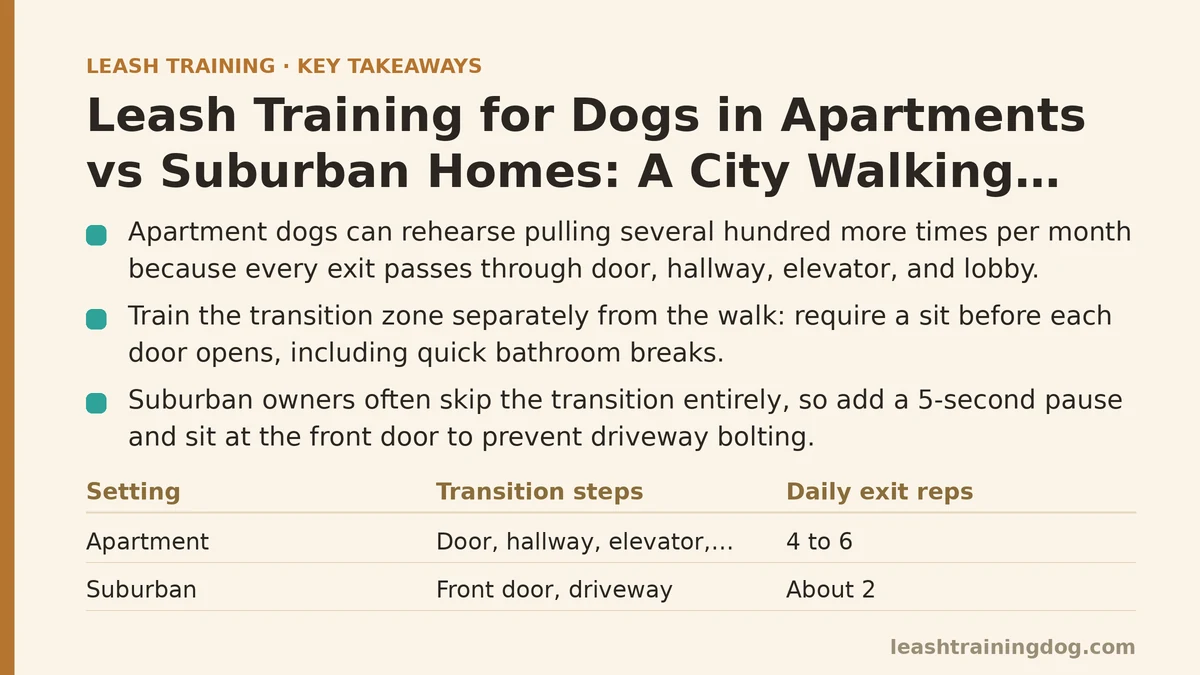
In a suburban home, a dog with a pulling habit rehearses it maybe twice a day: once leaving the house, once returning. In an apartment building, that same dog may cross the threshold, the hallway, the elevator, and the lobby four to six times daily just for bathroom breaks. Each crossing is a rep. Over a month, an apartment dog can accumulate several hundred more pulling repetitions than a suburban dog on the same training plan.
The fix is not to train harder. It is to train the transition zone deliberately and separate it from the actual walk:
- Do a “sit before the door” ritual every single exit, including quick bathroom breaks at 6 a.m. when you are half awake. Door opens only when the dog is calm and behind the threshold line.
- Use the elevator as a training station, not a transport. Ask for a sit at the door, wait for the doors to open, then walk in on your cue. Reward calm standing inside. This converts a stress point into a daily 30-second practice session.
- Keep leash length short (roughly 1 to 1.5 meters) until you reach the sidewalk. A long line in a narrow hallway teaches the dog to surge ahead.
If your building has a lobby with multiple doors, treat each door as a separate checkpoint rather than one long exit. The dog learns a pattern: pause, calm, proceed.
What Does Suburban Leash Training Get Wrong?
Suburban homes have the opposite problem: the transition is so short that owners skip it entirely. The dog is in the driveway in four seconds, and the leash training is assumed to start once the walk begins.
Two habits tend to develop from this:
The driveway dash. The dog bolts out the front door because nothing has ever required them to hold position there. This is easy to prevent — a 5-second pause and a sit at the door — but it is easy to forget because the environment is low-pressure.
The vanishing sidewalk. Many suburban streets have no sidewalk, so the walk happens on the road shoulder or a grass verge. Dogs pick up scent trails, loose dogs on the other side of a hedge, or the local mail carrier, and the owner has no physical barrier to manage the encounter. A 2-meter leash and a reliable “let’s go” are the practical tools here, since there is no fence or building wall to act as a natural boundary.
The suburban advantage is real, though: fewer daily exits mean fewer chances to rehearse pulling, and a quieter street usually means a shorter distraction ramp. A dog trained with consistent daily sessions tends to reach loose-leash reliability slightly faster in a suburban setting than in a dense city block.
How Do Distraction Levels Compare Between the Two?
This is where the two environments diverge most sharply. A suburban walk and an apartment walk are not the same task, and the training progression should reflect that.
| Distraction Type | Apartment / City | Suburban |
|---|---|---|
| Pedestrians passing within 2 m | Constant — dozens per walk | Occasional — a few per walk |
| Other dogs on leash | High frequency, often close | Moderate, often across the street |
| Moving vehicles | Constant, including buses | Moderate, mostly predictable |
| Scooters / cyclists on sidewalks | Frequent and unpredictable | Rare |
| Strong scent trails | Continuous on urban blocks | Seasonal, concentrated on verges |
| Stairs, elevators, lobbies | Multiple per trip | None |
| Expected time to a quiet training spot | 5–15 minutes | Under 2 minutes |
The practical consequence: an apartment dog needs a much earlier introduction to distance-based distraction work — practicing recalls and loose leash at 10, 20, then 30 meters from a busy corner. A suburban dog can start at that same level with much less preparation, but will need extra work on novel surfaces and environments if you ever visit a city, because the sudden noise and density can overwhelm a dog that has never practiced there.
A simple rule: train where you live, then deliberately visit the other environment once a month if your dog will encounter it — a city dog visiting a quiet park for calm, a suburban dog visiting a busy street for exposure. Keep those visits short (15–20 minutes) and lower your expectations for the first few.
What About Potty Breaks, Time, and Cost?
Time and cost differ in ways that affect how much training bandwidth you realistically have.
- Exit count: Apartment dogs commonly go out 4–6 times per day for bathroom breaks; suburban dogs with a fenced yard may only take 2 formal walks. That means apartment owners get more reps but less recovery time between them.
- Walk prep time: An apartment walk adds roughly 3–5 minutes per outing for leash-up, hallway, elevator, and lobby. Across six daily exits, that is 18–30 minutes per day of transition time — time that suburban owners simply do not spend.
- Equipment cost: Basic leash-and-collar setups run roughly $20–$40 for either setting. City owners often add a shorter traffic leash (about $15–$25) for crowded sidewalks, and a front-clip harness (roughly $30–$55) for stronger pullers. Suburban owners may add a long line (15 m, about $20–$30) for off-leash practice in parks.
- Rent and deposit: Many apartment buildings charge pet rent of roughly $25–$75 per month plus a one-time deposit; this rarely affects training directly, but it raises the practical cost of mistakes like a dog that barks at every elevator neighbor.
For a city dog, the training budget is usually better spent on more short sessions during transition zones than on longer walks. For a suburban dog, a daily 15-minute dedicated training walk (separate from the potty or exercise walk) tends to produce faster progress.
How Should You Structure Daily Sessions Differently?
Here is a straightforward before-and-after comparison for each environment.
Apartment routine — before (common mistake):
- Leash on in the doorway, dog already pulling.
- Ride elevator with dog straining at the door.
- Walk out the lobby at full speed.
- Train “loose leash” only once on the busy sidewalk, when the dog is already over threshold.
Apartment routine — after (recommended):
- Leash on while the dog holds a sit; door opens only when calm.
- Walk the hallway on a short leash, pausing at the elevator.
- Practice one 30-second “stand and wait” inside the elevator.
- Exit the lobby with a cue, then begin the walk.
Suburban routine — before (common mistake):
- Open the front door, dog bolts to the driveway.
- Walk starts at whatever pace the dog sets.
- Training happens only when a problem appears.
Suburban routine — after (recommended):
- 5-second threshold pause at the door, then release on cue.
- Walk the first 50 meters at a deliberate, slow pace to set the tone.
- Practice one “let’s go” turn and one “wait” at a curb before the walk ends.
If X, Then Y: A Quick Decision Guide
Use these branches to adapt the plan to your specific situation.
- If your dog pulls mostly in hallways and elevators → prioritize threshold and elevator training for two weeks before adding any new distance work.
- If your dog is perfect indoors but pulls the moment the lobby door opens → the trigger is the exit itself, not the walk. Practice “door opens, we wait” ten times per exit for one week.
- If your dog pulls on busy sidewalks but walks well on quiet streets → you have a distraction problem, not a leash problem. Increase distance from crowds first, then gradually decrease it over several weeks.
- If your dog walks well in the suburbs but panics in the city → treat a city visit as a separate training environment and lower your criteria: 10 minutes of calm walking counts as a success.
- If your building has no elevator and uses stairs → practice “wait” at the top of each flight and walk down beside your dog rather than ahead of them. Stairs are a common place for pulling to go unnoticed.
- If your dog is reactive to other dogs → keep the leash short in corridors, use a front-clip harness for control, and consult a qualified trainer or veterinary behaviorist if reactivity is intense or escalating.
What Are the Most Common Mistakes, and How Do You Recover?
Mistake 1: Training only on the “real” walk. In apartments especially, the four quick bathroom trips are where most pulling gets rehearsed. Recovery: apply the same door and hallway rules to every exit for one week, even when you are in a hurry.
Mistake 2: Using a long line in a hallway. A 5-meter line in a 2-meter corridor teaches the dog to surge and then hit the end of the leash. Recovery: switch to a 1–1.5 m leash indoors and save the long line for open parks.
Mistake 3: Assuming a suburban yard replaces walks. A fenced yard provides exercise and bathroom access, but it does not teach leash skills. Recovery: schedule at least one structured leash walk per day, separate from yard time.
Mistake 4: Escalating the environment too fast. A city dog taken straight from a quiet side street to a tourist-packed plaza will often regress. Recovery: step back one level of distraction, hold there for a week, then advance again.
Mistake 5: Ignoring recovery after a bad session. If a walk turns into a pull-fest, end it calmly on a positive note — a short sit, a reward, a quiet route home — rather than pushing through. Rebuilding from a bad rep is slower than preventing one.
What to Do Next
Pick one change and apply it starting today, rather than trying to overhaul the entire routine.
- Apartment owners: implement the door-and-elevator ritual on every exit for the next 7 days, and keep a short leash (1–1.5 m) until you reach the sidewalk.
- Suburban owners: add a 5-second threshold pause at the front door and one structured 15-minute training walk per day, separate from potty breaks.
- City visitors from the suburbs (and vice versa): schedule one 15–20 minute exposure session in the unfamiliar environment this month, and judge success by calm behavior, not distance covered.
If your dog’s pulling is severe, accompanied by reactivity, or has not improved after several weeks of consistent practice, a professional trainer or your veterinarian can help identify whether there is an underlying medical or behavioral issue worth addressing first.
What does your dog’s daily exit look like — hallway and elevator, or front door and driveway? That single detail usually determines which of these fixes will make the biggest difference first.