Walking your own dog and walking a dog while you are on the clock for a client are two different jobs that look identical from across the street. The leash, the harness, and the dog are the same. The stakes are not.
When you are walking your own dog, a distracted sniff stops at the mailbox. When you are walking a client’s dog during a home visit, a distracted sniff can pull you off balance on a wet ramp, put you in the path of a wheelchair, or leave a client waiting at the door. The task is the same length of nylon. The responsibility is entirely different.
This guide is written for home health aides, personal care assistants, and family caregivers who bring or manage dogs during visits. It focuses on the practical leash skills that keep both you and the client safe, and on the decisions you need to make before the first walk.
Myth vs. reality: the two things people confuse
Most of the confusion around caregiving and dogs comes from treating two roles as one.
| Myth | Reality |
|---|---|
| “A calm dog at home will behave the same on a leash during a visit.” | A dog can be relaxed indoors and still lunge at the door when a nurse arrives. Leash behavior is situational, not a fixed personality trait. |
| “If the client’s dog pulls, that’s just how the dog is.” | Pulling is a learned response to a lack of consequence, not a breed default. It can be managed with the right equipment and a consistent routine. |
| “Bringing my own dog to a visit is a nice touch that makes the client happy.” | It can be, but only if the client has agreed in advance and the dog has a reliable set of skills. An unplanned dog can be a liability and a distraction from care. |
| “Leash training takes weeks of formal sessions.” | Basic safety management — a front-clip harness, a short line, and a consistent grip — can be set up in a single visit. Formal training is a separate project. |
| “I need to correct the dog’s pulling with a sharp jerk.” | Leash jerks are a common cause of injury and can damage trust. Steady pressure and redirection work better and are safer for a caregiver who is focused on two things at once. |
If you take one idea from this table, let it be this: the dog is not the problem. The setup is.
Before the visit: the decision checklist
Run through this list before you commit to bringing a dog — yours or a client’s — into a caregiving context.
- Has the client explicitly agreed to the dog being present? Written consent is better than a verbal yes.
- Is the dog vaccinated and free of obvious illness? A vet record is not a formality; it protects an immunocompromised client.
- Does the dog have a reliable response to its name? You need at least one attention cue that works indoors before you rely on it outdoors.
- Is the client steady on their feet and able to be left briefly? If not, a second caregiver or a family member needs to be present before any walk happens.
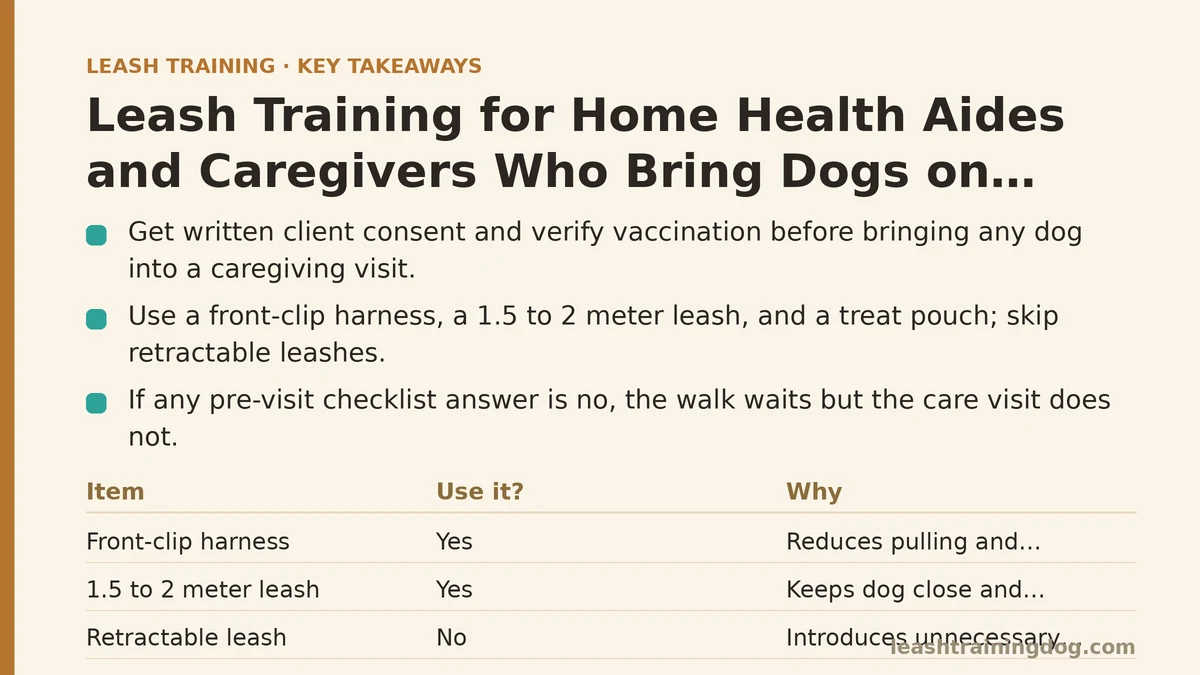
- Do you have the right equipment? A front-clip harness, a 1.5 to 2 meter leash, and a treat pouch cover most situations. A retractable leash does not.
- Is there a safe route? Identify a 5 to 10 minute loop with sidewalks, no steep ramps, and a place to step aside if you meet another dog.
If any answer is “no,” the walk waits. The visit does not.
Equipment: what to use and what to skip
The equipment you choose should be boring and reliable. Novelty gear introduces variables you do not need when your attention is split between a client and a leash.
| Item | Use it? | Why |
|---|---|---|
| Front-clip harness | Yes | Redirects pulling sideways, reducing the force transferred to your arm. |
| 1.5–2 m fixed leash | Yes | Short enough to keep the dog close at a door or crosswalk. |
| 4–6 m long line | Yes, in enclosed areas only | Useful for supervised sniffing in a fenced yard; not for street walking. |
| Retractable leash | No | A locking mechanism can fail, and the line can wrap a leg or a walker. |
| Prong or choke collar | No | Higher injury risk, and a poor fit for a caregiver whose hands are not always free. |
| Head halter | Sometimes | Effective for strong pullers, but requires an introduction period and a client who is comfortable with it. |
| Treat pouch | Yes | Reward-based training is the standard approach; a pouch keeps rewards accessible. |
A front-clip harness paired with a short fixed leash is the default recommendation for caregiving contexts. It is the least likely setup to fail at the exact moment you are not looking.
If X, then Y: common situations and how to respond
Caregiving walks rarely follow a script. Use these branches to decide quickly.
- If the dog pulls toward another dog, then stop, shorten the leash to no more than 1 meter, and step behind a parked car or a doorway until the other dog passes. Do not jerk or shout. Resume walking once the dog’s attention returns to you.
- If the client calls you from inside while you are outside, then bring the dog to a stop and return to the door with the dog at your side. Never leave a leash dangling or tied to a railing while you go inside.
- If the dog refuses to walk past a noisy object such as a stroller or a delivery truck, then turn around and take a different route. Forcing a fearful dog forward teaches the dog that the leash predicts stress.
- If you are injured or pulled off balance, then drop the leash rather than fall. A loose dog is recoverable; a fallen caregiver is not.
- If the visit runs long and the walk is rushed, then shorten the route rather than cut the leash skills. A two-minute walk done well is safer than a ten-minute walk done badly.
Recovery from a mistake is straightforward: reset, stand still for a few seconds, and start again at a closer distance with an easier task. Dogs recover from a bad moment faster than from a panic response from you.
The most common mistakes and how to fix them
These are the errors that come up most often when caregivers bring dogs on visits.
Mistake 1: Treating the walk as a break. The walk is part of the visit, not a recess from it. Keep your phone in your pocket, keep your attention on the dog and the route, and keep the walk short.
Mistake 2: Using the client’s dog as a teaching project mid-visit. Formal leash training takes consistent sessions. Do not introduce new training goals during a caregiving visit. Use the visit for management — the harness, the short leash, the steady pace — and leave the training plan for a dedicated session with the consent of the client or family.
Mistake 3: Assuming the client knows how to hold the leash. If the client wants to walk their own dog during your visit, take a minute to check the grip and the leash length. A loop wrapped twice around the wrist is a common and dangerous habit; a wrist gets broken in a fall.
Mistake 4: Skipping the reward because you are busy. Without rewards, the dog learns that the leash predicts nothing in particular, and pulling gradually returns. A handful of treats delivered for walking near you keeps the pattern intact.
Mistake 5: Pushing through an obviously bad day. Some days the dog is agitated, the weather is poor, or the client is anxious. On those days, skip the walk. A missed walk is a minor inconvenience; a fall is not.
The two-minute leash reset
If you only have a few minutes during a visit, do this instead of a full walk.
- Put on the front-clip harness and clip the short leash.
- Stand still in the doorway for 30 seconds and wait for the dog to stop pulling.
- Take five steps forward; if the leash tightens, stop and wait. Repeat five times.
- Reward the dog once at the end of the sequence.
- Remove the harness and end on a calm note.
This routine takes about two minutes and does more for leash manners than a rushed twenty-minute walk does. It also fits inside a visit schedule without cutting into care tasks.
What to do next
Pick one thing from this guide and put it in place before your next shift.
- Today: switch to a front-clip harness and a fixed 1.5 to 2 meter leash if you are not already using them.
- This week: walk the same 5 to 10 minute loop on three separate visits and note where the dog pulls. The pattern will tell you which situations need a wider berth.
- Before you bring your own dog on any visit: get written consent from the client, confirm your dog’s vaccination status, and run a test walk in a quiet space with the client present.
- If the dog is a serious puller or shows reactivity: consult a professional trainer and, if there is any doubt about the client’s safety, their physician or care coordinator. Leash skills and medical decisions belong to different professionals.
The leash you hold during a visit is not just a tool for the dog. It is the boundary between a calm, safe visit and a fall that ends a caregiving relationship. Set it up deliberately, keep it short, and keep the walk simple.