By the time you finish reading, you will be able to look at your two or three dogs, identify which personality type each one brings to a walk, pair them in a sensible order, and know exactly what to train separately before you attempt a combined group walk — without one dog dragging you toward a bush while the other sits in protest.
Walking multiple dogs well is not the same skill as walking one dog well. Each dog brings a different set of instincts, energy levels, and triggers to the sidewalk, and the moment you clip two leashes to one hand, those personalities start interacting. A confident older dog can steady a nervous puppy. A reactive dog can set off a calm one. A high-energy herding breed can make a laid-back senior miserable. The secret is not a magic leash or a special harness — it is understanding each dog as an individual and building your walking system around that.
Below is a breakdown of the common personality types you will meet in multi-dog households, how to assess your own pack, and the training order that gets you from chaotic three-leash tangles to calm group walks.
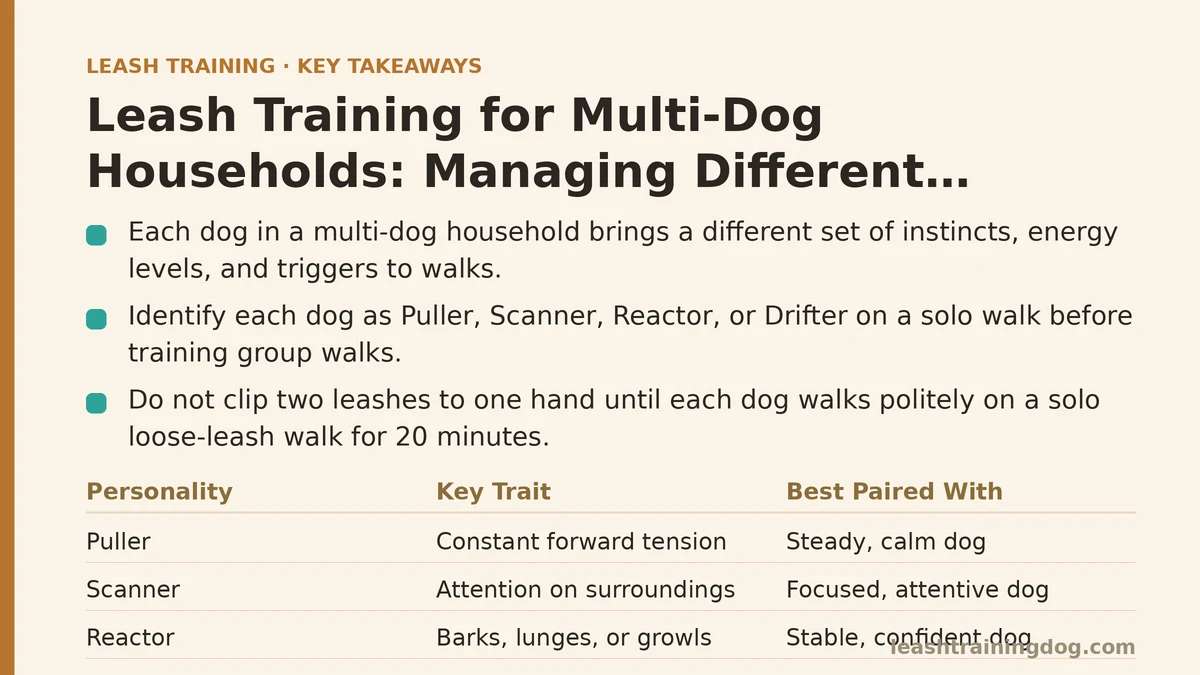
Know What You Are Working With: The Four Walk Personalities
Before you can train a group, you need an honest read on each dog. Sit with the following four categories and place each of your dogs in one. Most dogs fit one primary type with a secondary tendency. Watch them on a solo walk this week and take notes rather than guessing from memory.
The Puller. This dog walks with constant forward tension on the leash, often with their nose low and body leaning ahead. They are not necessarily reactive — they simply find pressure rewarding and movement reinforcing. A frustrated greeter can look like a puller, but a pure puller does not care about dogs or people specifically; they want to move forward.
The Scanner. This dog walks with their head up, ears rotating, and attention locked on everything except you. They stop to stare at a passing dog, a cyclist, or a rustling bush. They do not necessarily lunge, but their attention leaves the walk entirely. In a group, the Scanner teaches the other dogs to check out too, which is why a single Scanner can slowly turn your whole pack into a pack of distracted walkers.
The Reactor. This dog barks, lunges, or growls at a specific trigger — often other dogs, sometimes people, bikes, or cars. Reactors need their own training plan before they join any group walk. The good news is that a Reactor can be paired with a stable, confident dog once the Reactor has enough training under their collar to stay under threshold in your presence.
The Drifter. This dog walks beside you about half the time, then falls behind to sniff, then surges ahead for a moment, then checks in with you for a treat. The Drifter is not dangerous and not particularly difficult, but they have zero consistent position, which makes them unpredictable in a group. Two Drifters on one leash is chaos. One Drifter paired with a steady dog can be fine.
Take your time with this assessment. A 10-minute solo walk per dog, twice, on different routes, will give you a clearer picture than a month of chaotic group walks.
The Beginner Framework: One Calm Dog, Then Two
If you are new to multi-dog walking, start with a hard rule: you do not clip two leashes to your hand until each dog can walk politely on a solo loose-leash walk for at least 20 continuous minutes, on a route with normal distractions. That is not a luxury — it is the foundation that makes everything else possible. A dog that cannot hold loose leash alone will take the entire group down with them.
Once each dog passes that baseline, the beginner plan is this: walk two dogs at a time, never three, until you have ten successful two-dog walks under your belt.
Pair your most experienced walker with your least experienced walker. In practice, that means the confident, steady dog goes next to the dog who needs a role model. Walk the experienced dog on the side of your body that the nervous dog tends to drift toward — that blocks the nervous dog from bolting past you. Using the experienced dog as a moving fence, rather than as a trainer, is the goal. The calm dog’s presence lowers the anxious dog’s arousal naturally, without a single correction.
What to avoid in a beginner pair: two Pullers, two Reactors, or a Reactor and a Scanner. Any of those combinations will compound the problem rather than solve it. Keep your pairs to one strong, one needing support — and never pair two dogs that feed each other’s excitement.
The Intermediate Framework: Introducing Different Pairs
Once you have ten successful two-dog walks, you can start pairing more deliberately based on what you want to improve. This is where personality management becomes a genuine skill rather than a vague hope.
Puller + Drifter. Walk the Puller closest to your body and give the Drifter the outside position. The Puller’s forward tension, if it appears, pulls you toward the Drifter’s side, which naturally keeps the Drifter from wandering too far out. Keep the Puller on a front-clip harness — the same models recommended in my harness comparison, like the Ruffwear Front Range — to redirect tension before it ever reaches your arm.
Scanner + Puller. This pairing uses the Puller’s momentum to keep the Scanner moving. A Scanner that stops too long will get a gentle nudge from the Puller’s forward pressure at the other end of your body. That small, constant motion prevents the Scanner from fixating. The danger: if the Puller’s forward tension spikes, the Scanner will follow the pull and both dogs will surge. Keep the Puller on a short, firm leash with a front clip, and keep your own walking pace brisk.
Reactor + Stable Dog. This is an advanced pairing, not a beginner one. The Reactor must already be below threshold on a solo walk when another dog appears at a moderate distance. Then, and only then, pair the Reactor with your most bombproof, unflappable dog. Walk the stable dog on the side where the trigger usually appears. When another dog comes into view, the stable dog’s relaxed body language — soft ear position, loose leash, steady pace — gives the Reactor a live reference for what calm looks like. You are not just training the Reactor to respond to you; you are giving them a social model.
The Advanced Framework: Three Dogs, The Two-Leash Rule
Walking three dogs on three separate leashes held in one hand is how you end up wrapped around a lamppost. The advanced method that consistently works is the two-leash rule: one leash in each hand, with the third dog’s leash clipped to either your belt loop (if the dog is under 15 kilograms) or to the back D-ring of the weakest walker’s harness (if the dog is larger).
Here is the pairing logic for a three-dog household:
- The anchor dog — your calmest, most reliable walker — goes on the outside of one hand, opposite your dominant hand.
- The problem dog — whether that is the Puller, Scanner, or Reactor — goes on your dominant hand, closest to your body, so your strongest reactions go to the dog that needs them most.
- The third dog clips to the anchor dog’s harness back ring. The anchor dog does the steering; the third dog follows the anchor’s hips. This only works if the third dog is not a Puller or Reactor themselves. A Drifter or a mild Puller works fine here.
This setup keeps your dominant hand free to manage the unpredictable dog while the anchor does the passive work of carrying the third dog’s leash. The third dog rarely even notices they are clipped differently — they are simply following the anchor’s movement, which is already the pattern they know from the house.
Watch for this — if the third dog starts pulling forward hard enough to drag the anchor dog sideways, the pairing is wrong. Swap the anchor and the third dog, or drop back to two dog walks until the third dog has more solo training.
Training the Individual Before the Group
Every multi-dog household that consistently has calm walks tends to share one habit: prioritizing solo training even after the group walks are going well. Once a week, take each dog out alone. This is not just maintenance — it is the reset button that prevents the group dynamic from eroding each dog’s individual skills.
During that solo walk, spend 10 minutes on the specific weakness you identified in the assessment phase. The Puller works on sustained loose-leash walking with sudden stops that reward checking back with you. The Scanner works on “look at me” games — treat when they voluntarily return attention to your face after noticing a distraction. The Reactor works on threshold-distance counter-conditioning exactly as outlined in my leash reactivity guide. The Drifter works on a solid heel position with frequent position changes.
These solo sessions are also your diagnostic tool. If the Puller starts pulling again on solo walks, that tells you the group walks are becoming too demanding — reduce group frequency and rebuild solo. If the Scanner is more distracted than usual, it means their stress load is rising, likely from a recent bad group encounter.
Troubleshooting Common Multi-Dog Walk Failures
No matter how well you plan, specific failure patterns appear. Here are the ones I see most often and what is driving them.
One dog drags the other into a bad behavior. If your calm dog starts pulling only when paired with your Puller, that is not the calm dog regressing — that is shared arousal. Dogs synchronize behavior in groups, and the Puller’s tension raises the calm dog’s baseline excitement. Fix: separate them for a few weeks, strengthen each dog’s solo foundation, and reintroduce with the calm dog on a different side of your body than before.
Both dogs get excited as you clip the leashes. Pre-walk arousal is contagious. If the leashes trigger zoomies and barking before you even open the door, you have accidentally trained “leash = party.” Fix: desensitize the leashing routine. Clip leashes on, stand in the house for 2 minutes of quiet calm, then unclip. Do this ten times in one session before you ever leave the door. Repeat until clipping a leash produces zero reaction.
The group walk degrades after the first five minutes. The first few minutes are calm, then everything falls apart. This is fatigue or overstimulation kicking in, and it often means your walk is too long for the weakest walker in the group. Drop the total duration by half and watch whether the degradation point moves. If it does, you have found the limit. Walk that duration consistently for two weeks, then extend by five minutes.
One dog refuses to walk while the others are ahead. This is usually a confidence issue, not a stubbornness issue. A nervous dog stops because the pace of the group feels overwhelming. Fix: stop the entire group when this dog stops. Wait for them to take one step forward, mark with a calm “yes,” and continue slowly. Do not drag. Do not leave the dog behind. The other dogs will learn that forward movement only happens when the whole group moves together.
The Quick Pairing Guide
Use this as a starting reference when you are deciding which order to clip your dogs in for a group walk.
| Dog 1 | Dog 2 | Best Position | What to Expect |
|---|---|---|---|
| Confident walker | Nervous walker | Confident on outside, nervous on your body side | Nervous dog calms within a few walks |
| Puller | Drifter | Puller inside, Drifter outside | Drifter covers ground, Puller stays redirected |
| Scanner | Puller | Puller inside, Scanner outside | Constant motion keeps Scanner moving |
| Reactor | Stable dog | Stable dog between trigger side and Reactor | Reactor mirrors the calm dog’s body language |
| Two Pullers | Any third dog | Do not pair alone — use a third calm anchor | Pulling compounds; separate and train solo |
Setting Realistic Expectations
Multi-dog walking is a training project measured in months, not sessions. Most households see consistent, calm two-dog walks within four to six weeks of daily work. Three-dog walks typically take another four to six weeks on top of that, because you are managing more variables and the third dog needs to learn to follow from a clipped position.
What you should not expect is perfection. Around-moving vehicles, wildlife, or an off-leash dog running at you will disrupt any pack. The goal is not to eliminate all reactions — it is to shorten recovery time. A well-trained multi-dog group can have one dog spook at a skateboard, settle within seconds, and continue the walk without the other dogs escalating. That is the milestone worth measuring.
The Bottom Line
The order of operations never changes: solo assessment, solo training to a 20-minute loose-leash baseline, two-dog pairings with a strong and a weak dog, then and only then three-dog walks with the two-leash rule. Each step builds on the one before it, and skipping ahead is not faster — it is slower, because you will have to undo the bad habits the group dynamic creates.
Your calmest dog is your most valuable training tool. Use them deliberately. Let them demonstrate steady walking to the nervous dog and the Reactor. Pair them with the Drifter to keep the group moving. Attach the third dog to their harness and let them carry the passive work.
Which of the four walk personalities fits each of your dogs? List them in the comments — for example, “Puller + Reactor, both large” — and I will tell you the exact pairing order and training sequence I would start with this week.
Related guides: Common Leash Training Mistakes and How to Fix Them, Leash Training Small Breed Dogs: 5 Unique Challenges and the Exact Fix for Each, and Leash Training Your Dog to Walk Politely Around Distractions.