Say you are standing on your front porch at 9 p.m., watching a guest’s Labrador drag them down your gravel driveway toward the road, past the open gate you specifically asked them to keep closed. The guest is laughing nervously. The dog is not. And you are already calculating what a broken fence panel, an angry neighbor, or a liability claim would cost you this season.
That scene repeats at pet-friendly rentals far more often than most hosts expect, and the cause is rarely a “bad dog.” It is almost always a missing system: no clear leash policy at check-in, no designated relief area, no gate or threshold protocol, and no realistic way for a traveling owner to manage a dog in an unfamiliar space. Dogs behave differently on vacation because the entire environment is new, smells overwhelming, and the normal routines that keep them calm at home have disappeared.
This guide walks you through a practical sequence you can build once and reuse for every booking — from the listing description through checkout — for roughly the cost of a few hardware-store items and a couple of afternoons.
Step 1: Decide What You Are Willing to Host Before You Write the Listing
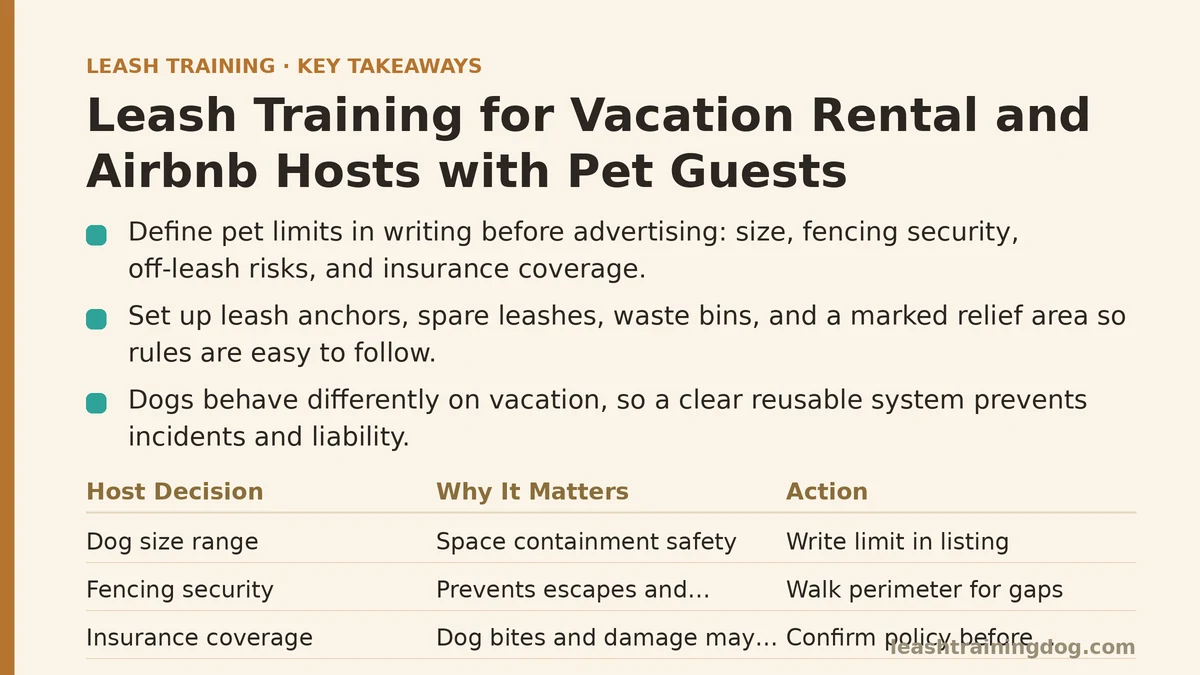
The most expensive mistakes happen before a guest ever arrives, when a host accepts “any dog” without defining limits. Before you add a single photo to your listing, answer four questions in writing.
- What size range can your space physically contain? A 60 kg dog on a 2-meter leash in a 30-square-meter studio is a different safety problem than a 5 kg dog in the same room.
- What fencing do you have, and is it secure? Walk the perimeter yourself. A 1.2-meter fence stops most small dogs but not a determined athletic medium breed. Gaps at the base and gates that swing inward are the two most common escape points.
- What is the nearest off-leash risk? Roads, livestock, unfenced water, or a busy trailhead within 100 meters all raise the stakes considerably.
- What is your insurance position? Many standard homeowner and short-term rental policies treat dog bites and dog-related property damage differently. Confirm coverage before you advertise as pet-friendly.
Write the answers into your house rules in plain language. “Dogs welcome up to 40 kg. Dogs must be leashed on the property at all times. Fence is 1.2 m and not suitable for jumpers or diggers.” Clear limits reduce booking friction later and give you something concrete to point to if a problem arises.
Step 2: Set Up the Property So Leash Rules Are Easy to Follow
Rules that require effort get ignored. Rules that come with a hook, a leash, and a clearly marked path get followed. A dog owner arriving after a six-hour drive will take the path of least resistance every time — so make the correct path the easiest one.
Hardware and layout essentials:
- A sturdy anchor point near the door — a wall-mounted ring rated for at least 50 kg, positioned where a dog cannot wrap the leash around furniture.
- A spare 1.5-meter and a 5-meter leash hanging by the main exit. Guests forget leashes at a rate that will surprise you.
- A covered waste bin with a supply of bags placed within 5 meters of the designated relief spot.
- A clear, marked relief area — a small gravel or mulch patch at least 3 meters from the entrance, not on the lawn where children play.
- Childproof or self-closing latches on every gate on the exit route.
- A slip-resistant entry mat at each exterior door. Tile and hardwood plus a wet, excited dog is a slip-and-fall claim waiting to happen.
Choose one door as the “dog door” and physically block or lock others if you can. Every additional exit multiplies the chance of a dog bolting into an unsecured area.
Step 3: Write Check-In Instructions That Take Under Three Minutes to Read
Long rulebooks get skimmed. A single page with a clear sequence gets followed. Structure the dog section of your welcome guide in this order:
- Where the leash, bags, and bin are.
- Where the designated relief area is, with a simple diagram or photo.
- The two leashing rules: on the property, and at the trailhead or street.
- The gate and door protocol — “keep the inner door closed before opening the outer door.”
- One sentence on what to do if the dog slips a leash: “Do not chase. Call the dog, kneel, and wait. Contact us immediately at [number].”
Add a short line acknowledging the reality of travel: “First 24 hours in a new place are the hardest for most dogs. Expect more pulling and more barking than usual — that is normal.” This frames the guest’s expectations and reduces blame if a dog behaves differently than at home.
Step 4: Run a Five-Minute Verbal Handover at Arrival
If you greet guests in person, spend five minutes on the dog, not just the Wi-Fi password. Walk them through four things:
- The leash route. Physically walk with them to the relief area so they see the gate, the traffic, and the surface.
- The two-finger collar and harness check. Show them how to test fit — two fingers should slide comfortably under any strap.
- The threshold routine. Have them practice: dog sits, door opens, dog waits, then releases. If their dog has never done this, suggest they hold the collar as the door opens rather than trying to out-muscle a lunging dog.
- The “leave it” cue for wildlife. Deer, squirrels, skunks, and groundhogs are common triggers in rural and suburban rentals, and the pulling behavior usually spikes around them.
Five minutes of demonstration prevents a much longer phone call at midnight.
Step 5: Match Leash Equipment to the Guest Dog’s Real Behavior
Guests arrive with whatever gear they already own, which is often not suited to your property. Use this table as a quick decision guide if you keep spare equipment on hand or want to advise a guest.
| Guest Dog Behavior | Recommended Setup | Avoid | Why |
|---|---|---|---|
| Calm, walks loosely | Standard 1.5 m flat leash + flat collar | Retractable leash | Retractables teach constant tension and give poor control near roads |
| Pulls hard on walks | Front-clip harness + 1.5–2 m flat leash | Back-clip only harness | Front clip redirects momentum sideways instead of rewarding forward pull |
| Reactive to other dogs or people | Front-clip harness + short 1 m traffic handle | Long line in open areas | Short handle keeps the dog within arm’s reach during sudden lunges |
| Senior or injured dog | Padded harness + 1.5 m leash, slow route | Neck-only collar | Reduces strain on the throat and joints |
| Strong, 40 kg+ dog | Front-clip harness or head collar + double-ended leash | Any single plastic-hardware harness | Metal hardware and dual connection points survive real force |
If you keep loaner gear, stock two sizes of front-clip harness and two flat leashes. A basic set typically costs $40 to $70 total and lasts multiple seasons if inspected between bookings.
Step 6: Prepare for the Three Most Common Vacation Dog Problems
Vacation rental dog incidents cluster into three recurring patterns. Each has a simple mitigation.
Problem 1: The dog bolts through an open door or gate. Prevention: install self-closing hinges on the main exit, keep a leash pre-clipped to the door hook, and instruct guests to use the “back-up and wait” routine rather than grabbing for a fleeing dog. If a dog does escape, running after it usually turns the escape into a game. Advise guests to call the dog’s name once, kneel or crouch, and wait, or to open a car door, which many dogs will voluntarily enter.
Problem 2: The dog barks at every footstep, guest, or passing car. Prevention: note in the listing whether the property is on a busy street or near shared walls. Suggest guests bring a familiar blanket, a white-noise machine, and a long-lasting chew for the first evening. If barking becomes a repeated nuisance complaint, escalating to a professional trainer consultation is the right move — not a longer rulebook.
Problem 3: The dog damages doors, screens, or furniture around the exit. Prevention: place a sturdy mat and a chew toy just inside the door to redirect exit-related anxiety. Check doors and screens between guests, and photograph condition at check-in so damage conversations are based on evidence rather than memory.
Step 7: Build a Between-Booking Reset Routine
The ten minutes you spend after each checkout determine how smooth the next arrival goes. Use a short checklist:
- Inspect fence line, gates, and latches — walk the full perimeter.
- Check for digging at fence bases and under doors.
- Wipe down the anchor point and inspect for chew damage.
- Restock waste bags and empty the outdoor bin.
- Launder any loaner blankets or harness padding.
- Photograph door frames, screens, and thresholds for damage records.
- Confirm the relief area has not become a mud pit — top it up with fresh material.
Keep a simple log of incidents and near-misses. Over two or three seasons, patterns emerge: the same gate that guests forget to close, the same corner where dogs mark, the same trailhead where pulling spikes. Each pattern points to a physical fix you can make once.
What to Do If Something Goes Wrong Mid-Stay
If a guest’s dog causes damage, injures another dog, or bites a person, act in this order:
- Ensure safety first. Separate animals and people before discussing anything.
- Document immediately. Photographs, timestamps, and any witness contact details.
- Do not attempt to retrain a stressed guest dog mid-stay. Suggest the guest contact their own trainer by phone or video if the issue is behavioral, and consult a veterinarian for any injury or sudden behavior change.
- Contact your insurer and, if a bite occurred, the local animal control office as your jurisdiction requires.
- Follow up in writing within 24 hours while details are fresh.
Serious behavioral problems — repeated biting, extreme panic, aggression toward people — are beyond what a host can manage. Recommend the guest seek a certified professional trainer or veterinary behaviorist. That recommendation protects the dog, the guest, and your property.
The Bottom Line
Pet-friendly bookings reward hosts who build a system, not hosts who simply allow dogs. The work is front-loaded: clear rules, a marked route, the right loaner gear, and a five-minute handover at check-in. After that, most stays run themselves, and you get fewer midnight phone calls, fewer damaged gates, and better reviews from guests who felt their dog was welcome and well managed.
The one action to take today: walk your property as if you were arriving with a strange 30 kg dog after a long drive. Note every gate, gap, slippery surface, and unmarked exit, then fix the two easiest ones this week. That single exercise prevents more incidents than any paragraph of house rules ever will.
Related guides: Leash Training Your Dog to Walk Politely Around Distractions, Front Clip vs Back Clip Harness: Which is Better for Your Dog?, and Teaching Recall to Your Dog: A Beginner Step-by-Step Tutorial.