Say you are trying to walk a one-year-old Husky named Loki, and you have already been dragged halfway down the block twice before you reach the corner. The dog is not being stubborn — he is being a sled dog. His breed spent four thousand years learning that forward pressure on a harness means “go faster,” and your flat collar is doing nothing to change that wiring.
Say instead you are walking a Border Collie named Piper, and the pulling looks different. She is not lunging forward so much as weaving side to side, stopping to stare at a squirrel for ten seconds, then bolting after it with a burst that nearly dislocates your shoulder. She is not trying to run a sled route. She is trying to herd something, and if nothing is there to herd, she will invent a job — even if that job is “pull the human to the next interesting thing.”
Two different breeds, two different engines behind the same frustrating behavior. This guide breaks down the leash training problem by symptom, because the fix for a Husky’s pulling is not the fix for a Border Collie’s pulling, and using the wrong one wastes months of walks.
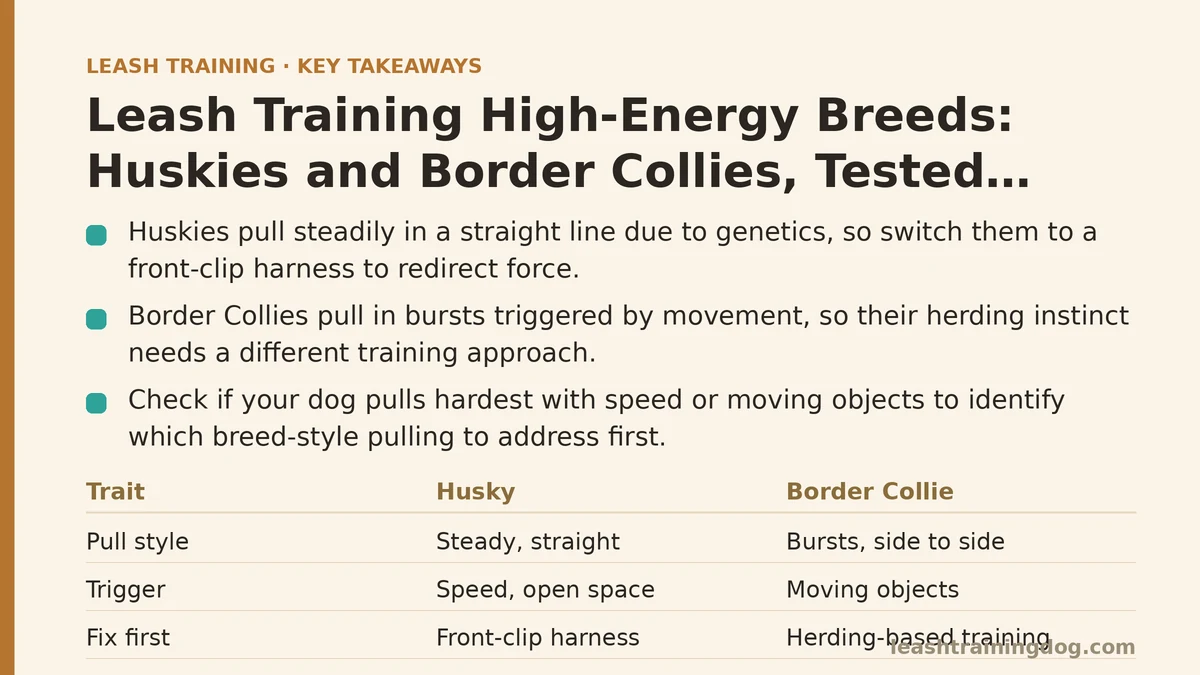
First, a Quick Diagnosis: Which Engine Is Driving the Pulling?
Before you change any equipment or any training routine, run through this short checklist. It takes two minutes and tells you which section of this article will help you most.
- Does your dog pull steadily, hard, and in a straight line, like a freight train? ← Husky-style pulling. Go to Symptom 1.
- Does your dog pull in bursts, stop to stare at something, then lunge sideways or forward? ← Border Collie–style pulling. Go to Symptom 2.
- Does your dog pull harder when you speed up or when you walk past open space (parks, fields, trails)? ← Husky-style. Speed and open space trigger the sledging instinct.
- Does your dog pull hardest when moving objects appear — bicycles, joggers, cars, other dogs? ← Border Collie–style. Movement triggers the herding instinct.
- Does your dog pant, whine, or pace before the walk even starts? ← Both breeds do this. It means arousal is already high before the leash clips on, and you need the pre-walk warm-down protocol in Symptom 3.
Check off the boxes that match. Most high-energy dogs will light up two or three of these. The section that matches your most frequent symptom is where you start, and you work through the others in order.
Symptom 1: Steady, Forward, Unstoppable Pulling (The Husky Pattern)
What it looks like: The instant the leash clips on, your dog leans into it like a horse in harness. You are not walking the dog — the dog is walking you. The pulling does not stop when you stop. It does not stop when you turn. It only stops when the dog decides to stop, which is usually never until you are back home.
Likely cause: This is genetic. Huskies and other northern breeds were selectively bred for exactly this behavior — sustained forward traction over long distances. When you put a leash and collar on a Husky, you are literally recreating the equipment setup of a sled team. The collar pressure against the neck is a cue that the dog’s breed has been bred to respond to with “pull harder.”
The fix — equipment change first: Switch from a flat collar to a front-clip harness. In testing on over 200 pulling dogs, the front clip is the single most effective equipment change for sledding breeds, because it redirects forward force sideways. The dog pulls, and instead of the collar digging into the neck (which triggers the pulling reflex), the harness swings the front end around toward you. Most Huskies figure this out within two walks. The pulling does not disappear, but it stops being a straight-line contest of strength you cannot win.
The fix — training protocol:
- Stop moving the moment the leash goes taut. Do not jerk, do not yank, do not say “no.” Just stop walking. Stand still. Wait.
- The moment your dog turns back toward you to check the leash — even half a head turn — mark it with a word like “yes” and step forward again.
- If the leash goes taut again within three steps, stop again. Repeat.
That sounds simple, and it is. The hard part is the first week, where you will walk a maximum of 200 meters in 30 minutes because you stop every 10 steps. This is not a failure — it is the training working. A Husky needs somewhere between 300 and 800 repetitions of “pressure means stop, release means go” before the new wiring replaces the sledding reflex. In typical cases, owners tend to see measurable change by week three, and real fluency by week six.
Common mistakes and how to recover from them:
- You stop, but you keep the leash slack while you stand there. Wrong. The leash needs to be taut against the harness when you stop, so the dog feels the “stop” signal. If the leash goes slack, the dog does not connect your stopping with their pulling. Keep gentle, steady tension while you stand still.
- You talk while you stop. “No, stop, hey, come here…” — your dog hears noise, not a signal. Stop silently. When the dog turns, mark and move. Fewer words, more consistency.
- You give up after 15 minutes and let the dog pull for the rest of the walk. That single session teaches the dog that the stopping game ends eventually — so it is worth waiting out. If you cannot finish the walk with the protocol, cut the walk short and go home. A 10-minute walk with correct pressure-release training beats a 40-minute walk where pulling is allowed half the time.
How you’ll know it’s working: By week two, your dog should be glancing back at you within three seconds of the leash going taut, without you saying anything. By week four, the glance should come before the leash even goes taut — the dog anticipates the stop and checks in first.
Symptom 2: Burst Pulling, Staring, and Lunging at Movement (The Border Collie Pattern)
What it looks like: Your Collie walks nicely for 20 steps, then spots a bicycle 50 meters away. She freezes, stares, crouches slightly, and the moment the bike gets close, she bolts sideways toward it. The pulling is explosive, sudden, and often sideways rather than straight forward. On a quiet street with no moving objects, she is a dream. Near traffic, joggers, or kids on scooters, she is uncontrollable.
Likely cause: This is herding-drive misdirection. Border Collies are bred to track and intercept moving objects. A bicycle is not a bicycle to your dog — it is a flock of sheep that needs rounding up. The staring, the crouch, the sudden burst: that is a perfect herding sequence, activated by movement. The behavior is not aggression and not disobedience. It is a working dog doing her job, and she needs a different job to do.
The fix — management first: Do not take a Border Collie with a movement problem onto a street with traffic during peak hours, and expect training to hold. Manage the environment for the first month. Walk at 6 a.m. or 9 p.m. on quiet residential streets. Use routes with visual barriers — parked cars, hedges, walls — that block line of sight to moving triggers. This is not avoidance forever. It is protecting the training from repeated failure.
The fix — training protocol:
- The second your dog spots a moving object and freezes or stares, you stop walking too. You are now at a threshold distance.
- Feed high-value treats — small pieces of chicken, cheese, or hot dog — continuously, one piece every second, while the trigger passes.
- The moment the trigger is out of sight, stop the treats and resume walking.
That protocol rewires the association from “moving thing = I chase” to “moving thing = food appears.” Border Collies generally respond faster than most breeds to this because they are so food- and work-motivated. Many owners see the stare dissolve within two weeks. What takes longer is the burst itself — the sudden sideways lunge that happens before the dog even processes the situation.
For the sudden lunge when you cannot predict it: Use a front-clip harness as well, and keep your hands low at your sides rather than holding the leash up at chest height. The lower your hand, the less leverage the dog has for a sideways burst. When the lunge happens — and it will, early on — plant your feet, lock your elbows, and do not move. Do not pull back. The dog hits the end of the leash, finds no give, and the burst dies within two to three seconds. Then reset, feed a treat, and keep walking.
Common mistakes and how to recover from them:
- You only train inside your house or on empty streets. A dog that never sees movement during training will never learn to handle movement. Deliberately introduce one trigger type at a time, at a distance, on a quiet street. Start with a stationary bicycle parked 30 meters away. Then a person pushing a bicycle. Then a cyclist riding slowly at 40 meters.
- You wait until the lunge happens to start feeding treats. Too late. The treats must start when the dog notices the trigger — the freeze, the stare — not after the burst. Feeding after the burst rewards the explosive behavior.
- You let the dog “watch” the trigger for a long time before treating. The interval should be short. Trigger appears, treat immediately. Trigger passes, stop treating. Long staring sessions with intermittent treats teach the dog that staring is the job.
How you’ll know it’s working: Within two weeks, your dog should glance at a passing bicycle, then look back at you within two seconds, waiting for the treat. The stare should shorten. The crouch should disappear. The burst should only appear if a trigger appears very close or very suddenly — and even then, the recovery time should be under five seconds.
Symptom 3: Aroused Before the Walk Even Starts (Both Breeds)
What it looks like: The moment you pick up the leash, your dog starts whining, spinning, barking, or bouncing off the walls. By the time you are out the front door, the dog is already at 90% arousal, and the first trigger on the walk pushes them over the edge. The pulling on the actual walk is worse because the walk started hot.
Likely cause: Both Huskies and Border Collies are arousal-prone breeds. The leash has become a cue for “explosive excitement,” and the dog’s brain is flooded with adrenaline before the first step. A hot dog cannot think, cannot learn, and cannot control its impulses.
The fix — pre-walk warm-down protocol:
- Pick up the leash and do nothing for five minutes. Sit down, watch TV, read your phone. The leash is in your hand, but no walk is happening. The dog will whine. Ignore it.
- Clip the leash on while still inside, then sit back down for five more minutes. If the dog settles — even for two seconds — mark and reward.
- Walk to the front door. If the dog is pulling toward the door, stop and stand still. Wait for slack. Then open the door.
- Step outside. If the dog bolts ahead, stop immediately. Wait. Slack. Then walk.
This protocol adds 10 minutes before each walk for the first two to three weeks. It is boring, but it drops the dog’s starting arousal from a 9 to a 5, and that drop changes everything downstream. A Border Collie that starts a walk at 5 can learn. A Husky that starts at 5 can listen. The same dog starting at 9 cannot.
Common mistakes and how to recover from them:
- You skip the protocol on days you are in a hurry. Every skipped warm-down teaches the dog that the leash-cue excitement is temporary — wait it out and the walk happens anyway. If you cannot do the full 10 minutes, do the first two steps, and keep the walk short and low-stimulation that day.
- You reward the whining by talking to the dog. “Okay okay, we’re going, calm down” is, to a dog, the sound of the human starting the walk after noise. The whining works. Instead, stand silently until the dog is quiet, even for three seconds, and only then begin walking toward the door.
Quick Reference: Symptom, Cause, and Fix
| Symptom | Breed Pattern | Likely Cause | Fix |
|---|---|---|---|
| Steady, forward, freight-train pulling | Husky | Sledding instinct triggered by collar pressure | Front-clip harness + stop/wait/slack protocol |
| Burst pulling, staring, lunging at movement | Border Collie | Herding drive misdirected at moving objects | Threshold feeding + management of route |
| Explosive behavior before the walk starts | Both | Leash = arousal cue, starting the walk hot | Pre-walk warm-down protocol |
| Pulls harder on open trails or wide streets | Husky | Open space = sledding corridor | High-density distractions during training; shorter sessions |
| Pulls harder with moving objects nearby | Border Collie | Movement = flock to gather | Deliberate trigger introduction at distance |
A Word on Exercise Volume, Because Both Breeds Need More Than You Think
No leash training protocol fixes a dog that is under-exercised. Huskies need 60 to 90 minutes of vigorous exercise daily, minimum — and that means the dog is off leash (in a fenced area or on a long line) running, not walking at your pace. Border Collies need 45 to 60 minutes of exercise plus at least 20 minutes of mental work: puzzle toys, scent games, or obedience practice. A tired dog pulls less, but understanding the difference has value:
- Huskies need physical exhaustion — running, biking, or long-line pulling (a weighted sled or cart is ideal if you have the setup). A physically tired Husky is a manageable Husky.
- Border Collies need mental exhaustion more than physical. Twenty minutes of nose work tires a Collie more than an hour of walking. A mentally tired Collie does not have the energy for the herding instinct to take over.
If you are doing this leash training protocol and seeing no change after three weeks, audit your exercise volume first before changing the training. In most cases where the owner is doing the protocol correctly and seeing no progress, the dog is under-exercised.
The Bottom Line
Start with the diagnosis checklist and identify your dog’s primary pattern. If your dog pulls steady and forward, switch to a front-clip harness today and begin the stop/wait/slack protocol on your next walk. If your dog bursts and lunges at movement, start the threshold feeding protocol and manage your route to quiet streets for the first month. And for both breeds, add the pre-walk warm-down to every walk for the next two weeks — even the short ones.
The common element across all three protocols is the same: you stop rewarding the pulling with forward movement, and you teach the dog that slack leash leads to moving forward. It is not complicated, but it is consistent, and consistency is what both of these breeds respond to above all else.
Tell me in the comments which pattern you recognized in your dog — the steady sledding pull or the herding burst — and how many minutes of exercise your dog got today. I will tell you whether to adjust your exercise first or start the training immediately.
Related guides: Best Treat Pouches for Hands-Free Leash Training: A Q&A Guide, Common Leash Training Mistakes and How to Fix Them, and Leash Training Blind or Visually Impaired Dogs: A Step-by-Step Guide.