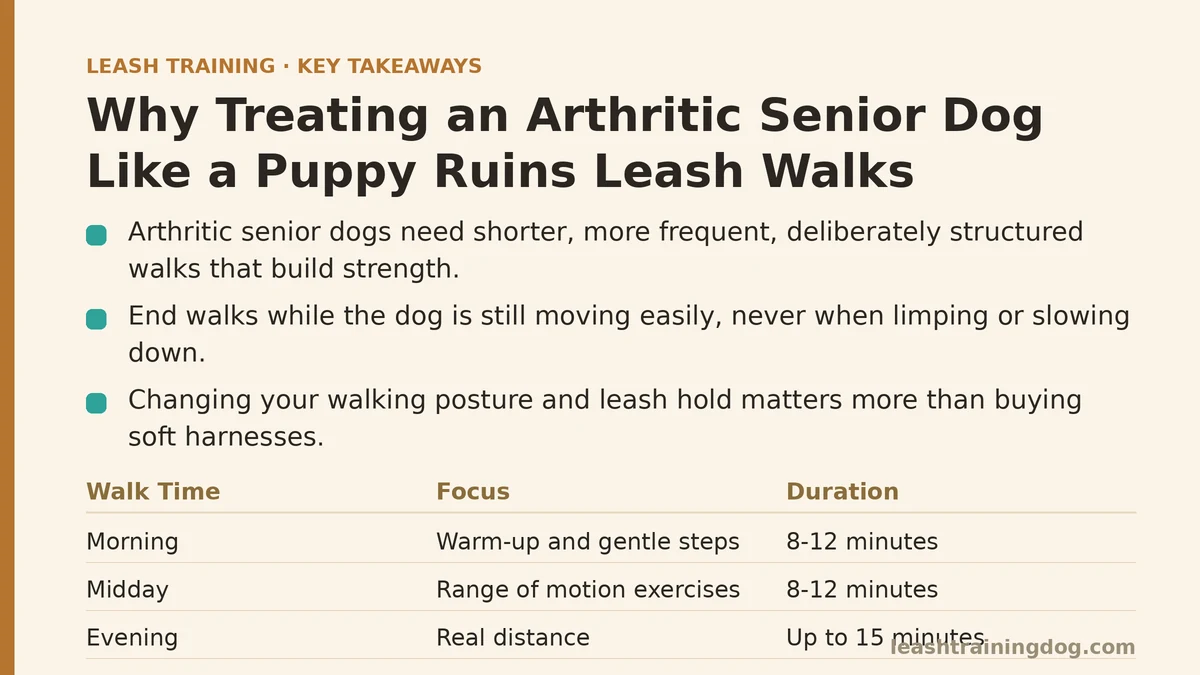
The misconception that costs more senior dogs their quality of life than any injury is this: an arthritic dog needs shorter, slower, gentler walks. In practice, it is the opposite. What an arthritic dog needs is shorter, more frequent, deliberately structured walks that build strength — and a leash handling style that stops robbing them of the little momentum their stiff joints can produce.
People who spend years rehabilitating leash habits for dogs over nine years old tend to see an unmistakable pattern. The owners who succeed are not the ones who bought the softest harness or the stretchiest leash. They are the ones who changed their own walking posture, their leash hold, and their idea of what a successful walk looks like. This post walks you through that process, using an example dog as the thread.
Meet Max: A Nine-Year-Old Labrador Fading Fast on Walks
Max arrived with a classic story. His owner, a retired teacher named Diane, had been told by two separate vets that Max had moderate hip and elbow arthritis. The recommendation was “rest, gentle walks, and joint supplements.” Diane followed the advice faithfully. Max’s walks shrank from thirty minutes to ten, his pace dropped to a shuffle, and within three months, he started refusing to leave the driveway entirely.
By the time a dog like Max is brought in, he is often not in a pain crisis. He was in a movement crisis. His muscles had weakened from the reduced walks, which meant his joints had less support, which made each step harder, which made Diane shorten the walks further. A downward spiral, driven by the best intentions.
The turning point came when we stopped asking how long can Max walk and started asking how often can Max move well.
The First Change: Walk the Dog, Then Walk the Joints
Most owners structure a senior dog’s walk as one continuous block — ten minutes out, ten minutes back. For an arthritic dog, that single block works against them. The first five minutes are the hardest because the joints are cold and the synovial fluid has not warmed up. By the time Max was comfortable, Diane was turning around for home, and the return trip was the most painful part of the whole session.
We restructured Max’s day into three walks of eight to twelve minutes each. Morning walks started with a slow, warm-up minute — standing still, gentle massage along the spine and hips, then a few steps forward, a few steps back, no leash pressure at all. The midday walk focused purely on range of motion: walking in slow circles, backing up two steps for every five forward, and pausing every thirty seconds to let Max stretch his front legs out into a bow position.
The evening walk was the only one that covered real distance, and even that was capped at fifteen minutes. The rule was simple: stop while Max is still moving easily, never when he is limping or slowing down. That meant ending the walk at eight minutes on bad days, twelve on good ones. Diane struggled with this at first — she had been told to push through her dog’s stiffness to keep him strong. In practice, pushing through limping inflames the joint and teaches the dog that walking predicts pain. Ending on the upswing teaches the opposite.
The Leash Hold That Changed Everything
Here is the mechanical detail that made the biggest visible difference within two weeks. Diane was holding Max’s leash in her right hand, with the slack draped across her body, from the clip at his chest, up across her torso, to her right shoulder. Every time Max took a stride that was slightly off — a stumble, a hesitation, a wince — the slack tightened and pulled his chest slightly upward and back. It was a small correction, too subtle for Diane to feel, but Max felt it every single step.
Switching a dog like Max to a front-clip harness — such as the Ruffwear Front Range, a model commonly recommended for dogs that pull — and changing the handler’s hold can help. Her left hand held the leash with her elbow bent at ninety degrees, the leash running straight down to the chest clip with zero slack. Her right hand rested on a loop of leash near the clip, ready to act as a shock absorber. Her job was not to guide Max. Her job was to keep the leash totally dead — no tension, no vibration, no accidental tugs.
The difference in Max’s gait was immediate. Dogs with joint pain hold their heads lower and shift weight to their front limbs to unload sore hips. Any upward tension on the leash — even two pounds — forces them to lift their head and neck, which transfers more weight backward onto the very joints that hurt. A dead leash lets the dog choose their own head position, which for an arthritic dog is usually hunched forward slightly to spare the hips. That posture looks worse to an owner but feels better to the dog. Diane learned to read Max’s comfort from his tail and ear position rather than from his head height.
Rethinking the Walk’s Purpose: It Is Muscle, Not Miles
Here is what most guides for senior dogs get wrong. They focus on pain relief — softer surfaces, shorter distances, better harnesses — but they ignore the strength component. Arthritis is progressive, but its rate of progression is largely determined by the muscle surrounding each joint. Strong quadriceps and hamstrings act as shock absorbers for the hip. Strong shoulder and elbow flexors stabilize the front limb. A dog with good muscle mass around a mildly arthritic joint can walk comfortably for years. A dog with poor muscle mass around that same joint will decline quickly.
So the most valuable leash training tool for a senior dog is not a gentler collar or a padded harness. It is the owner’s willingness to use the leash for strength exercises rather than for transportation. Every walk with Max included deliberate, leash-guided movements that built the specific muscles his joints depended on:
- Side-stepping along a curb — walking with his body angled so his front paws stayed on the sidewalk and his hind paws on the grass, strengthening the hip abductors.
- Sit-to-stand repetitions — five slow repetitions of sitting and standing at each lamppost, using the leash to support his chest on the way down and to encourage him through the sit without letting him collapse.
- Slow circle walks — weaving figure-eights around two trees, which works the inner and outer thigh muscles in a way straight-line walking never does.
These exercises take less than ten minutes total per day, and they are what made the difference between Max shuffling out of the driveway and Max trotting down the block with his tail at a ninety-degree angle. His vet noted measurable improvement in his rear-leg muscle mass at the three-month checkup, without any change in medication.
The Question of Pain: How to Read Your Dog During the Walk
Owners of arthritic dogs often ask me how they can tell whether they are pushing too hard or not enough. The answer is not to watch the dog’s legs. Legs hide pain well — a limping dog will still put weight on a sore joint for several steps before a visible hitch appears. The reliable signals are smaller and appear earlier.
- Lip licking — a single lick of the nose that is not in response to food, repeated more than three times during a walk, is an early stress and pain marker.
- Yawning — one yawn in the middle of a walk, not at the start or end, means something is off.
- Head turn toward home — a dog that glances back at the driveway or slows down as you approach the turn-back point is telling you the walk is already one minute too long.
- Hesitation at a curb or step — an arthritic dog that used to step down without pause now hesitates for half a second. That half-second is the dog calculating whether the impact will hurt. If you see it, the walk has already passed the pain threshold.
When any of these appear, end the walk immediately — but end it gently. Turn around slowly, offer a treat, and let the dog set the pace back. Do not drag, do not praise the stopping, and do not schedule another walk until the dog is warm and rested.
What Not to Do: Common Mistakes That Worsen Joint Pain on Leash
Three mistakes appear in nearly every senior dog leash setup I evaluate.
Mistake one: the retractable leash. A retractable leash provides constant low-level tension — exactly what an arthritic dog does not need. The ratchet mechanism pulls against the dog slightly even when they are not moving, and when the dog does surge forward, the line snaps taut, transmitting a sudden jerk to the neck or chest. Use a fixed-length leash of 1.5 to 2 meters, held dead, at all times.
Mistake two: the collar. A flat collar puts pressure on the cervical spine when the leash tightens, and arthritic dogs often compensate by throwing their head forward, which compounds the issue. A front-clip harness is the minimum requirement for any senior dog with joint pain, because it redirects pressure away from the spine and toward the sternum, which can tolerate repeated loading without discomfort.
Mistake three: the “one more minute” rule. Owners often tell themselves that since their dog is enjoyably sniffing a bush, they can extend the walk by a few extra minutes. Sniffing is not the same as walking. The dog is standing still, often with one paw raised, which is a lower-impact activity than actual locomotion. If the dog chooses to stop and smell, that is a signal to hold position and let them rest — not a license to push further.
The Six-Week Progression I Use with Senior Dogs
If you want a concrete framework rather than a list of principles, here is a six-week plan that can serve as a baseline for many arthritic dogs.
Weeks one and two: Three walks daily, eight minutes each. Front-clip harness, dead leash, no pulling allowed from the owner. Warm-up minute at the start, cool-down minute at the end. Strength exercises limited to three sit-to-stands per walk. Watch for the five pain signals listed above and end the walk at the first appearance.
Weeks three and four: Increase each walk to ten minutes, and add the side-stepping exercise along a curb for thirty seconds per walk. Begin the figure-eight pattern around two trees — one lap each direction. Keep the sit-to-stands at five per walk.
Weeks five and six: Extend the morning walk to twelve minutes, keep the afternoon and evening walks at ten. Add a second lap of the figure-eight and an additional thirty seconds of side-stepping. At this stage, you should see a measurable change: the dog greets the leash with more enthusiasm, sets a slightly faster natural pace, and no longer hesitates at the curb.
If any week shows regression — increased hesitation, clearer limping, more frequent pain signals — drop back to the previous week’s duration and stay there for another seven days before trying to progress again. That is not a failure. That is the dog telling you the joint needs more time to rebuild the supporting muscle.
The Bottom Line for Your Senior Dog
An arthritic dog does not need less walking. They need smarter walking — shorter sessions, more frequent sessions, deliberate strength work, and a leash that stays completely dead in your hand. The moment you stop thinking of the leash as a control mechanism and start thinking of it as a support tool, everything changes.
You will know the approach is working when your dog starts pulling toward the door at walk time again, not away from it. That is the goal: not a pain-free walk, but a walk where the anticipation outweighs the ache.
How old is your dog, which joints are affected, and what does the current walk look like — duration, pace, and how they act when you reach for the leash? Tell me in the comments and I will help you adjust the plan above for your specific dog.
Related guides: Choosing a Puppy’s First Leash and Collar: The Professional’s Step-by-Step Guide, How to Leash Train a Dog With Severe Anxiety Before Walks: A Symptom-by-Symptom Fix Guide, and Puppy Walking Mistakes That Create Lifelong Leash Pulling.