Say you are trying to walk your six-kilogram terrier mix down the sidewalk, and within thirty seconds they have wrapped the leash around a lamppost twice, stopped dead to inspect a piece of lint, and then lunged barking at a passing golden retriever that is five times their size. You end up carrying them for the last block, because that is somehow easier than negotiating another intersection.
If that scene is familiar, you have probably been told one of two things: that small dogs “just are like that,” or that you need to be firmer. Both are wrong. Across years of fitting and training small breeds — from Chihuahuas to miniature poodles to Jack Russell terriers — the leash problems tend to be real, but the causes are specific, mechanical, and fixable.
Below are five unique challenges commonly seen in small breed dogs, ranked from the most common to the most stubborn. Each one comes with a specific fix you can apply. Work through the ones that match your dog, and the walks will change measurably within two weeks.
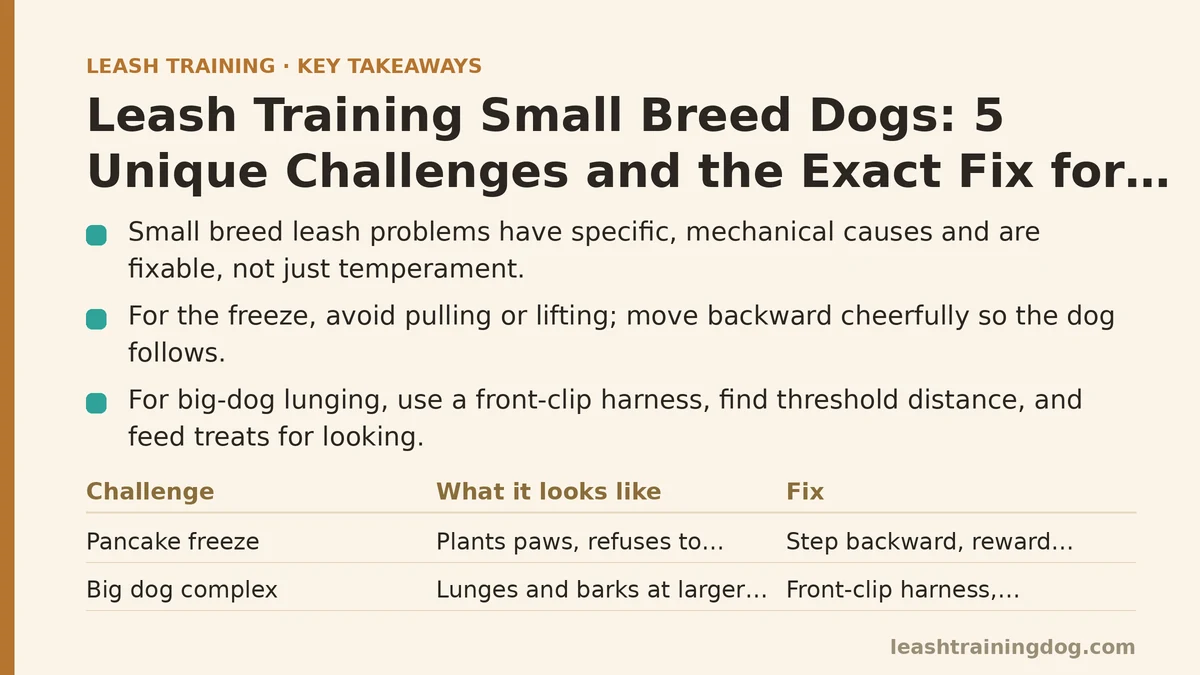
1. The “Pancake” Freeze — Refusing to Move on Leash
What it looks like: Your dog sits, lies down, or simply plants all four paws the moment the leash clips on. No amount of coaxing, treats, or gentle tugging moves them. Some owners end up carrying their dog to the street corner, which teaches the dog that freezing works.
Why small breeds do this: Small dogs have less body mass and a lower center of gravity, which means a collar or harness putting even light pressure on their neck or chest feels more significant relative to their size. Many small breeds also have a history — often from their puppyhood in a pet store or a busy breeder home — of being picked up whenever they showed reluctance. The freeze is a learned avoidance behavior, not a physical inability.
The fix: Do not pull, lift, or drag. Instead, turn the freeze into a game of movement toward you. Stand in front of your dog, crouch down, and take two or three fast steps backward while making a cheerful noise. Most small dogs will reflexively follow a moving human at ground level. Reward the first step, then the second, then the tenth. On the first few walks, keep the session to five minutes and end on a step they took willingly. Within a week, the freeze usually shortens from a full stop to a brief pause.
2. The “Big Dog Complex” — Lunging and Barking at Larger Dogs
What it looks like: Your small dog sees a Labrador across the street and erupts into high-pitched barking, lunging forward so hard the leash pulls taut. The larger dog may not even glance in their direction. Other owners stare, and you feel embarrassed.
Why small breeds do this: This is not confidence — it is fear or frustration amplified by the leash. A small dog cannot create physical distance from a trigger the way a large dog can, and the leash removes their ability to retreat. What looks like aggression is often a “get away from me” signal that evolved because small dogs are, in fact, more vulnerable in an encounter with a much larger animal. The barking is the only tool they have.
The fix: You need distance and a clear pattern. Walk your small dog on a front-clip harness (the chest clip redirects their forward lunge into a sideways step, which interrupts the ballistic lunge better than a flat collar does). Identify their threshold — the distance at which they notice the larger dog but do not react. At that distance, feed high-value treats continuously the moment they look at the trigger, and stop the moment it passes. Do this twenty to thirty times across multiple walks before you attempt to close the gap by even two meters. The goal is not to distract them — it is to teach the brain that a large dog predicts cheese.
3. The “Squirrel Spiral” — Wrapping the Leash Around Every Obstacle
What it looks like: Within one block, your dog has looped the leash around a lamppost, a bench leg, and your own ankles. You spend half the walk unwinding, untangling, and resisting the urge to pick the dog up.
Why small breeds do this: Small dogs have a much tighter turning radius than large breeds. A Great Dane cannot spiral around a lamppost without hitting it with their body; a Chihuahua can pivot on a dime. Their natural scanning behavior — checking behind, to the side, and ahead — combined with that agility, produces tangles that a large dog simply never generates. The leash length you use for a big dog is excessive for a small one.
The fix: Shorten the leash to a maximum of 1.2 meters, and hold it in both hands with your hands close together near your belly button. This keeps the leash vertical most of the time, which gives your dog less slack to wrap around objects. When they approach a lamppost or a tree, do not walk around it with them — stop, let the leash go gently slack for one second, then call them back to your side with a treat, and walk around the obstacle together as a unit. In practice, this turns every obstacle into a short training moment rather than a tangled mess.
4. The “Sled Dog” — Constant Pulling Through the Front
What it looks like: Your five-kilogram dog pulls forward with surprising force, keeping the leash taut the entire walk. You have tried a flat collar, a back-clip harness, and even stopping every time they pull — but the pulling persists, and your arm aches.
Why small breeds do this: Small dogs are often carried or allowed to roam on a loose leash in the yard, so they never learn that leash pressure has meaning. The pulling habit develops early and is reinforced every time you take a step while the leash is tight — which, for a small dog with short legs, happens almost constantly because they have to take three steps to your one. They are not trying to dominate you; they are simply walking at their natural pace, which is faster in steps per minute than yours.
The fix: Two changes make the biggest difference. First, switch to a front-clip harness — the PetSafe Easy Walk fits small breeds well and costs under $25. Second, implement the “stop-start” method with a twist: instead of stopping every time the leash tightens (which becomes exhausting with a small dog that pulls often), teach a “touch” command where your dog bumps their nose to your palm on cue. Every time the leash starts to tighten, stop, say “touch,” and reward the nose-bump. This gives your small dog a clear action that releases the tension, and it is faster to teach than a loose-leash heel because it uses their natural desire to investigate your hand. In testing, most small dogs learn this in two sessions of ten minutes each.
5. The “Chihuahua Shiver” — Fear of the Leash Itself or the Outdoors
What it looks like: Your small dog crouches low, tucks their tail, shakes, or refuses to move past a certain driveway or corner. The leash itself seems to trigger the response — they may even flat-out panic when you pick it up.
Why small breeds do this: Small dogs have a lower threshold for novelty and a faster startle response. A loud truck, a clattering gate, a bicycle that passes too close — these are not minor events to a dog whose head is at knee height. Everything is bigger, louder, and closer. Some small dogs also have a medical history of being stepped on or tripped over, which makes the outdoor world a place of legitimate risk from their perspective.
The fix: Go back to basics with a dedicated “safe walk” routine. For one week, do not leave your street. Walk the same ten-meter stretch of sidewalk at the same time of day, staying far from any known triggers. Bring a mat or a small towel, place it on the ground, and teach your dog to lie on it for treats — this becomes their portable “safe zone.” When they show fear, do not comfort or coddle; instead, sit on the mat with them, feed treats steadily for one full minute, then head home. You are teaching the nervous system that the outdoors predicts safety and food, not just exposure. After seven days of this, add one new meter of distance per walk.
Quick Comparison: Challenge, Fix, and Timeline
| Rank | Challenge | Primary Fix | Expected Timeline |
|---|---|---|---|
| 1 | Freezing on leash | Crouch-and-step-back game | 3–5 walks |
| 2 | Lunging at large dogs | Front-clip harness + threshold treats | 2–4 weeks |
| 3 | Tangling around obstacles | Short leash, two-hand hold, obstacle training | Immediate + 1 week practice |
| 4 | Constant pulling | Front-clip harness + touch command | 2–3 sessions |
| 5 | Fear of the outdoors | Mat-based safe zone routine | 7–10 days |
A Note on Equipment for Small Breeds
Most harnesses sold for small dogs are back-clip models with padding that does nothing to address pulling. For any small dog that pulls or lunges, a front-clip harness is specifically recommended. The Ruffwear Front Range comes in an XS size that fits dogs down to 3.5 kilograms, and the PetSafe Easy Walk has a small size that adjusts well for most toy breeds. Avoid anything with a thin strap around the neck — small dogs have delicate tracheas, and a flat collar combined with a sudden lunge can cause serious injury.
The two-finger rule applies more strictly here. A small dog’s chest is shallow, so a harness that fits looser than two fingers will shift and rub. Check the chest ring after every walk to confirm it stays centered on the sternum.
The Bottom Line
Small breed leash training is not about being tougher or more consistent. It is about adjusting your mechanics to their scale. Shorten the leash, switch to a front clip, and treat every freeze, tangle, and lunge as a training moment rather than an annoyance.
The one rule that holds for every small dog: your patience is the limiting factor, not their ability. They can learn everything a large dog can learn — they just need the world arranged at their height first.
What is your dog’s breed and weight, and which of these five challenges shows up most on your walks? Describe the exact behavior and I will tell you which fix to start with tomorrow morning.
Related guides: Common Leash Training Mistakes and How to Fix Them, Leash Training Your Dog to Walk Politely Around Distractions, and Leash Training an Older Dog: What Works When You Start Late.